ANCIENT GREEK WARNINGS · ATHENS · POWER
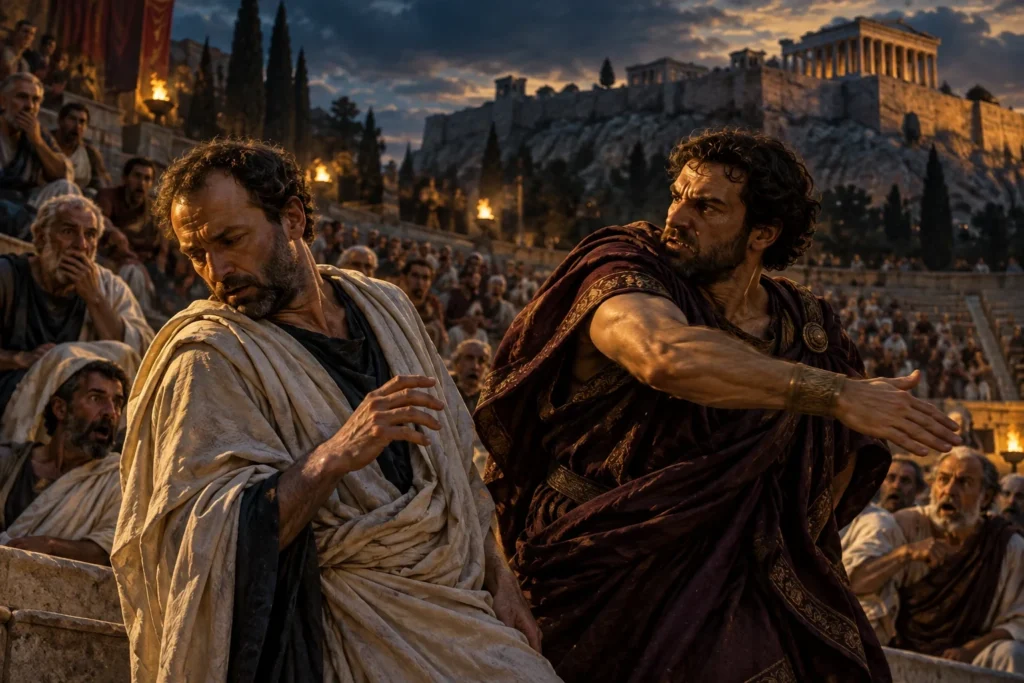
During a festival honoring Dionysus in Athens, a man struck one of the city’s most formidable speakers. The year was 348 BCE. The victim was Demosthenes and the alleged assailant was Meidias. According to Demosthenes, the punch was delivered in the theatre of Dionysus while he was serving as a chorus sponsor. It was not a private quarrel hidden from view. [1]
Why would a single blow become the subject of an extraordinary political and legal argument? The answer takes us to a meaning often missed in discussions of hubris in Greek mythology. The Greeks did not use hybris, commonly spelled hubris in English, only for the arrogance of a mortal who challenged the gods. They could also use it for the outrage of someone who treated another person’s honor as a thing to destroy. [2][3]
Today hubris usually means excessive pride. The old meaning was darker and more complicated. Sometimes it involved believing you stood above the gods. Sometimes it meant believing you stood so far above another human being that humiliating them became a pleasure. [2][3]
What Did Hubris Mean in Ancient Greece?
Hubris could describe outrageous conduct, contempt for someone else’s standing or an inflated sense of one’s own importance. These meanings overlap, but they are not identical. An epic poet, an Athenian prosecutor and a philosopher were not writing a single timeless dictionary entry. [2]
Honor mattered deeply in Greek social life. It was not just a private feeling. It involved the respect a person could claim from other people. In that setting, an insult could do more than hurt. It could announce, before witnesses, that the victim did not deserve the standing everyone else recognized. [2][3]
This explains why confidence by itself was not necessarily hubris. Ancient Greeks admired excellence and achievement. The danger began when a person’s success turned into a supposed right to ignore the limits or standing of others. Myth and tragedy could express that danger through clashes with gods. Athenian law could confront it through actions against other people. [2][4]
Why Did a Punch at a Festival Matter So Much?
In Against Meidias, Demosthenes returns again and again to the location of the attack. It happened during the Great Dionysia, a major public religious festival. He depicts the blow as deliberate humiliation, not merely an injury to his body. The audience and the sacred occasion mattered to the case he wanted to make. [1][4]
The speech discusses an Athenian legal action for hybris. A law-text transmitted within it covers offenses directed at a child, woman or man, whether enslaved or free. Demosthenes himself emphasizes that the city was concerned with the act and not only the identity of the victim. This is a striking feature of the evidence. It does not erase the enormous inequalities of Athenian society, and the authenticity of legal documents embedded in surviving speeches remains a matter of scholarship. [4][5]
There is another detail worth resisting the urge to tidy up. We do not have a secure record of a final courtroom conviction. Scholars have long debated whether Demosthenes delivered the surviving speech at all. An ancient report suggests the dispute may have been settled. The text gives us the argument Demosthenes prepared, not a courtroom recording with a guaranteed ending. [6]
That makes the episode more revealing rather than less. He wanted fellow citizens to see the public message behind the assault. To strike someone in such a place was, in his account, to display power through another person’s disgrace. [1][4]
Aristotle’s Disturbing Explanation
Aristotle brings the idea into sharper focus. In Rhetoric 2.2, he describes hybris as saying or doing things that shame another person for the pleasure of doing so. The offender is not simply trying to secure a practical benefit or retaliate for a wrong. He enjoys the act itself. [3]
Aristotle goes further. He says the aggressor imagines that mistreating someone else makes his own superiority more evident. He associates that impulse especially with people who possess the confidence of youth or wealth. This was Aristotle’s explanation of a social behavior, not a modern psychological diagnosis. [3]
Notice how ordinary the scene could be. No one needs to scale Olympus. No one needs to challenge Zeus. A person can display hubris by making someone else feel small and enjoying the power to do it.
Yet it would be a mistake to replace the familiar definition with the claim that hubris never involved pride. Classical scholarship stresses both the outward act and the outlook behind it. Someone who overestimates their worth, good fortune or entitlement may become less willing to recognize what is owed to others. The conduct and the attitude can feed each other. [2]
Hesiod’s Warning Was About Justice
Centuries before the Athenian courtroom speech, Hesiod opposed hybris to dikē, justice. In Works and Days, he urges his brother Perses not to nurture hubris and says that justice eventually prevails over it. The warning appears amid arguments about property, corrupt judgments and the behavior of powerful men. [7]
One image makes the point with startling simplicity. A hawk carries away a nightingale and mocks the weaker creature for resisting. The hawk has the strength to do as it likes. That does not make its conduct just. Hesiod follows the fable by telling Perses to listen to justice rather than feed hubris. [7]
This is not the familiar picture of a hero provoking a god and being punished by lightning. It is a problem inside a community. What happens when the powerful begin to mistake their ability to impose suffering for the right to impose it?
Hesiod even imagines an entire city suffering because of the wrongdoing of one man. His concern reaches beyond individual character into the consequences of unjust power. [7]
Niobe: A Warning That Is Not So Simple
In Book 24 of Homer’s Iliad, Achilles is sitting with Priam, the father of the man he has killed. He urges the grieving king to eat. To explain why life must continue even after unbearable loss, Achilles tells him about Niobe. [8]
Niobe had compared herself with Leto, mother of Apollo and Artemis. She had twelve children in Homer’s account while Leto had only two. Apollo and Artemis killed Niobe’s children. Later the gods buried them, and Niobe, exhausted by grief, remembered food. Homer leaves her mourning amid the rocks of Mount Sipylus. [8]

This has all the ingredients of a story about disastrous boasting. But here is the important distinction. Homer’s passage does not explicitly call Niobe’s action hybris. Achilles tells the story to a bereaved father, not to deliver a neat definition of arrogance. [8]
Niobe still belongs in our investigation because her comparison with a goddess reveals a perilous claim of superiority. But the passage has another center of gravity: a woman grieving for her children and a warrior asking an old man to eat after his son’s death. Reduce it to a moral slogan and much of its force disappears.
Xerxes and the Sea That Would Not Obey
Now consider a king who, according to a Greek historian, tried to punish the water itself.
Herodotus tells us that Xerxes ordered bridges built across the Hellespont for the Persian invasion of Greece. A storm destroyed the first bridges. The king, enraged, ordered the strait whipped three hundred times and a pair of fetters cast into it. Herodotus even records words addressed to the water as if it were a disobedient subject. [9]

That is an extraordinary image. But it is Herodotus’ report, not an incident independently established by physical evidence. His account also belongs to a Greek narrative of a Persian invasion. We need to recognize the storyteller’s perspective as well as the story he tells. [9]
Aeschylus makes a related warning explicit in The Persians, first performed in 472 BCE. The ghost of Darius reflects on Xerxes’ ruin and declares that blooming hybris bears a disastrous harvest. The play presents unrestrained ambition as a calamity felt by a whole people. [10]
The tragedy does not simply say that proud rulers deserve to fall. It asks what happens to everyone around them when political power refuses to recognize limits. The dead do not get to enjoy a ruler’s confidence. The surviving families must live with its consequences.
Was Arachne Punished for Being Too Good?
Arachne often appears on lists of Greek hubris myths. She is the gifted weaver who challenges Athena and ends as a spider. Yet the detailed version most readers know comes from Metamorphoses by Ovid, a Roman poet writing in Latin, not from a surviving classical Greek account. [11]
That difference matters because Ovid does not give us a simple lesson about an untalented mortal who should have known her place. Arachne really is brilliant. In his telling, Athena cannot find fault with the finished weaving. Worse for the goddess, the tapestry depicts unsettling behavior by the gods themselves. Athena destroys the work and strikes the artist. [11]
Arachne’s story is valuable as a later ancient treatment of rivalry, artistic excellence and divine authority. It should not carry the burden of defining classical Greek hubris on its own. It also leaves readers with a difficult question. Who, in that contest, is actually behaving with restraint?
Does Hubris Always Lead to Nemesis?
The formula hubris leads to nemesis is memorable. It is also too tidy to describe the whole ancient tradition. Nemesis can mean indignation or retribution and has its own history as both a concept and a personified power. Hesiod speaks about justice overcoming hubris, while Aeschylus uses an image of hubris flowering into ruin. Aristotle, meanwhile, examines the pleasure of humiliating others. They are related ways of thinking, not interchangeable definitions. [2][3][7][10]
Nor do ancient stories guarantee a punishment that modern readers will regard as proportionate. Niobe’s children suffer for a quarrel they did not begin. The Persian families in Aeschylus endure the consequences of their king’s ambition. A warning about overreach is not automatically a defense of every suffering that follows. [8][10]
There is power in leaving those uncomfortable questions open. The Greeks did not hand us one mechanical rule that makes every catastrophe deserved.
The Question Hubris Still Asks
Return to the theatre of Dionysus. Demosthenes wanted the people of Athens to see more than a blow. He asked them to see an act of public contempt. Aristotle would later supply language for the underlying satisfaction of treating someone else as inferior. [1][3]
The distance between a quarrel at a festival and Xerxes commanding the Hellespont is enormous. Yet the ancient texts show why both belong in the conversation. Hubris can emerge when a person begins to mistake an advantage for permission. Wealth becomes permission to shame. Power becomes permission to ignore limits. Success becomes permission to stop listening.
The Delphic maxim explored in Know Thyself in Ancient Greece offers a useful companion question about human measure. Our Ancient Greek Warnings archive collects other ancient patterns of danger while The Odyssey Explained follows the consequences of choices within Homer’s epic.
The question is not only how proud you are. It is what you have begun to believe your power allows you to do.
Frequently Asked Questions
What is hubris in Greek mythology?
Hubris commonly means dangerous pride or overreaching. In ancient Greek usage it could also refer to outrageous acts that dishonored others. Its emphasis changes across epic, tragedy, philosophy and Athenian law.
Is hubris the same thing as arrogance?
Not exactly. Arrogance describes a disposition. Hubris could involve both an inflated sense of superiority and conduct that showed contempt for other people’s standing.
What are examples of hubris in Greek mythology?
Niobe’s disastrous comparison with Leto is a useful mythic parallel. Greek accounts of Xerxes illustrate the dangers of royal overreach. Arachne is a familiar later ancient example, but the detailed surviving version discussed here belongs to the Roman poet Ovid.
Did ancient Greeks believe hubris was always punished?
Greek authors often connected hubris with reversal, disaster or divine justice, but they did not provide one universal sequence in which every offense automatically produces a particular punishment.
What is the difference between hubris and nemesis?
Hubris concerns outrageous conduct, excessive self-assertion or contempt for proper limits. Nemesis has a separate range of meanings related to indignation and retribution. They are connected in some traditions but are not synonyms.
Sources and Notes
- [1] Peter J. Wilson, “Demosthenes 21 (Against Meidias): democratic abuse,” The Cambridge Classical Journal. On the public assault at the Dionysia in 348 BCE.
- [2] Douglas Cairns, “Hybris,” Oxford Classical Dictionary. Revised 13 July 2026.
- [3] Aristotle, Rhetoric 2.2, 1378b23–30. On humiliation and perceived superiority.
- [4] Demosthenes, Against Meidias 21.45–47. The Athenian legal context.
- [5] Mirko Canevaro, The Documents in the Attic Orators. Chapter examining legal documents transmitted in Against Meidias.
- [6] Review of Douglas MacDowell, Against Meidias: Oration 21, Bryn Mawr Classical Review. Published 1991.
- [7] Hesiod, Works and Days 202–264. Translation by Gregory Nagy, Center for Hellenic Studies.
- [8] Homer, Iliad 24.602–620. The Niobe passage.
- [9] Herodotus, Histories 7.34–35. The Hellespont episode.
- [10] Aeschylus, The Persians 818–830. Including hybris at line 821.
- [11] Ovid, Metamorphoses 6.1–145. The contest between Arachne and Minerva.