ANCIENT GREEK RELIGION · MEMORY · THE UNDERWORLD
Imagine arriving in the Underworld with one terrible disadvantage. You are dead, thirsty and standing before a spring. The words carved on a tiny sheet of gold warn you not to approach it. Somewhere beyond lies another source of water, guarded and linked to Memory. The directions offer an unsettling clue to the ancient Greek afterlife. [1]
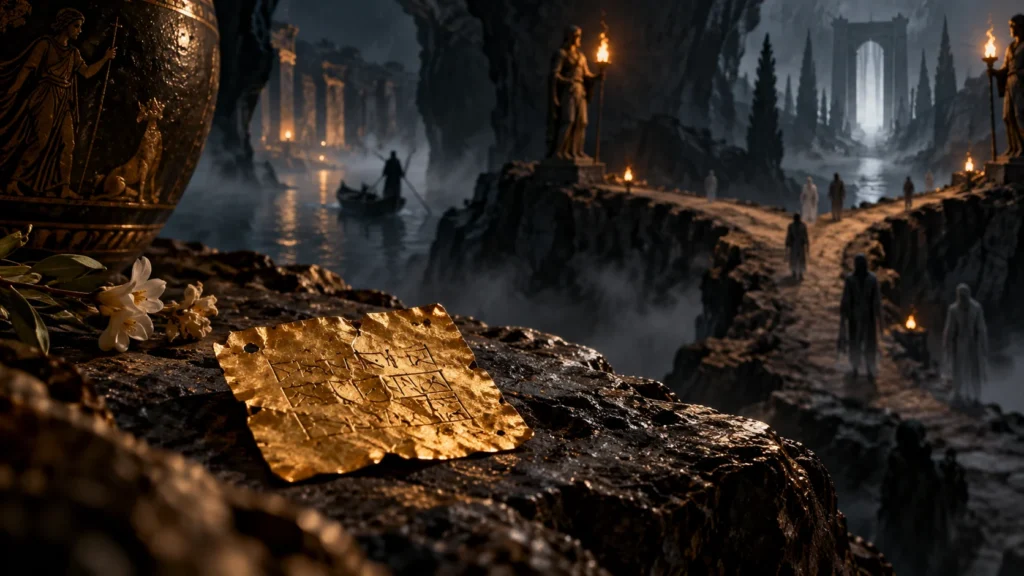
This was not an instruction invented for a modern fantasy story. A Greek gold tablet from Petelia in southern Italy, dated to the third or second century BCE, survives in the British Museum. The text offers directions for a journey after death. Another such object, now at the Getty Museum, dates to about 350–300 BCE and stages a remarkable exchange between a thirsty traveler and a spring. [1][2]
To understand the ancient Greek afterlife, we have to resist an easy answer. There was no single Greek account of what happened to everyone after death. Homer, mystery initiates and philosophers could imagine the next world in strikingly different ways. The gold leaves show how personal that difference could become. [3]
Did Ancient Greeks Believe in Life After Death?
Many ancient Greek stories imagine a continuing existence beyond the grave. The realm of Hades was associated with the dead and with the divine ruler who shared its name. But the popular shortcut of equating Hades with the later Christian idea of Hell distorts the ancient material. Being dead was not, by itself, proof of moral guilt or a sentence of punishment.
Greek literary texts describe different regions, exceptions and destinies. Not every dead person becomes a tortured criminal. Nor is every departed soul welcomed into an eternal paradise. The details change with the author, period and religious setting, which is precisely why the surviving evidence deserves to be read separately rather than blended into one imaginary map.
If we want to know what Greeks believed, we must first ask which Greeks and which evidence. An epic about a warrior’s journey is not the same kind of testimony as a funerary inscription placed beside a real person. Both matter, but they answer different questions. [3]
Homer’s Underworld Was Not a Reward
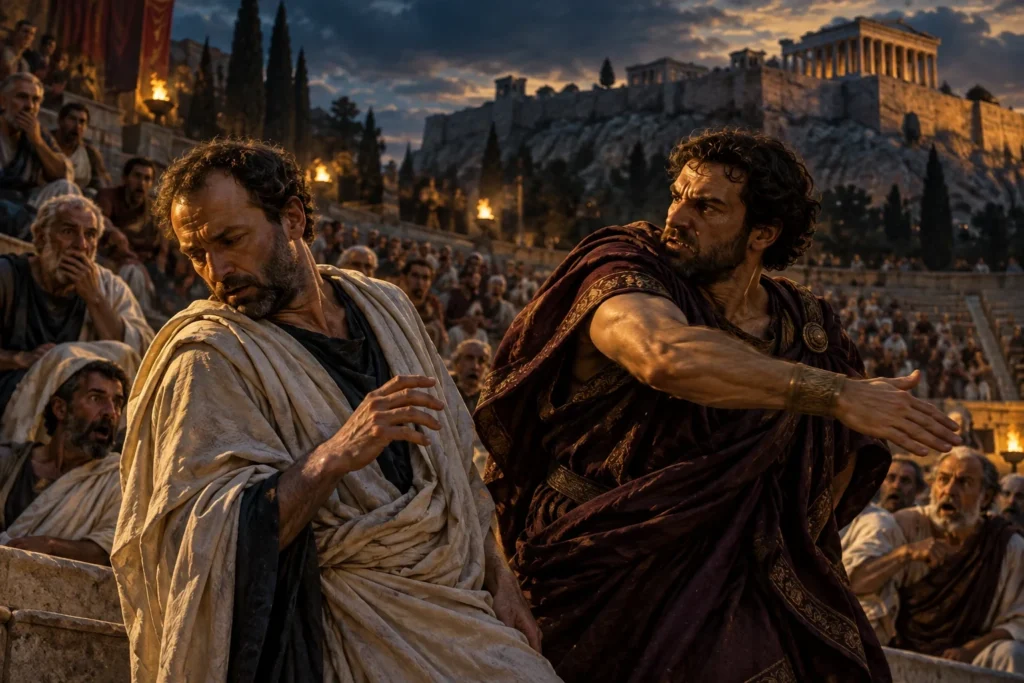
One of the bleakest passages in Greek literature comes in Book 11 of The Odyssey. Odysseus encounters the shade of Achilles, the warrior whose fame had made him almost impossible to rival in life. Odysseus assumes that Achilles must still enjoy a kind of greatness among the dead. Achilles rejects the comfort immediately. [4]
The dead hero would rather live in poverty as a servant than rule over those beneath the earth. That is not a small complaint. It turns the promise of immortal fame inside out: the most celebrated warrior in Greek epic considers even a difficult human life preferable to his status in death. [4]
The episode does not establish an official Greek doctrine. Homer gives other characters different stories. But it reveals a powerful fear: existence might continue while the substance of being alive is lost. For readers of our Odyssey investigation, this is another reason the poem is more disturbing than its monster-filled reputation suggests.
Now compare Achilles’ despair with a gold leaf that appears to tell its owner how to secure a different fate. The distance between those texts is the heart of the mystery. [3]
The Gold Tablets Buried with the Dead
The Petelia tablet is only about 4.5 centimeters long. It is a genuine Greek-inscribed gold object, now preserved with a chain and case in the British Museum. The museum dates the tablet to the third or second century BCE while identifying the surviving case as later, from the Roman imperial period. That distinction prevents us from treating every surviving part as one original burial assemblage. [1]
The Getty Museum preserves another inscribed example from roughly 350–300 BCE. The museum describes these thin leaves as rare funerary objects that could be placed on or near a deceased person’s body. Some contain directions while others proclaim status or offer responses to be spoken in the Underworld. [2]
These were not ordinary grave markers for the whole Greek population. Fritz Graf’s entry in the Oxford Classical Dictionary surveys a small and varied corpus spread across the Greek world over several centuries. Their scarcity makes them important evidence for particular communities and practices, not a universal burial custom. [3]
A tomb cannot explain everything its occupant believed. Yet this combination of text, precious material and burial context is unusual. Instead of hearing only what a poet imagined about the dead, we can examine a physical object chosen for someone’s final journey.
Two Springs and a Dangerous Choice
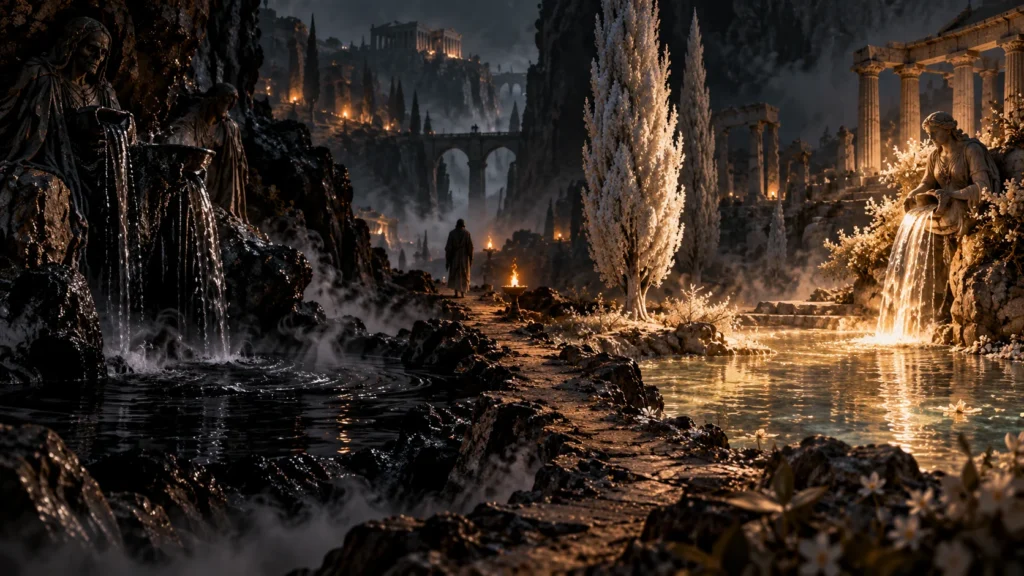
The Petelia inscription describes a spring near a white cypress tree and forbids the traveler from approaching it. Another water source lies farther on, associated with the Lake of Memory and watched by guards. It is not presented as a pleasant choice between equal alternatives. One path must be avoided if the traveler is to follow the instructions. [1][2]
But the surviving tablets do not always agree about which direction to take or what a cypress marks. The Getty’s example has a spring inviting the thirsty traveler to drink, with the cypress described differently. We should not quietly combine these texts into one consistent set of directions. The variations are part of the evidence. [2]
It is tempting to announce that the forbidden spring is the River Lethe, the water of Forgetfulness familiar from later Greek literature. But the Petelia instruction does not explicitly label that first spring with the name Lethe. Keeping the traditions distinct makes the genuine puzzle more interesting, not less.
Imagine the fear hidden in this scenario. You might reach the other world yet still make the wrong choice. Death is no longer the end of the story. It is the start of a test.
What Did the Dead Have to Say?
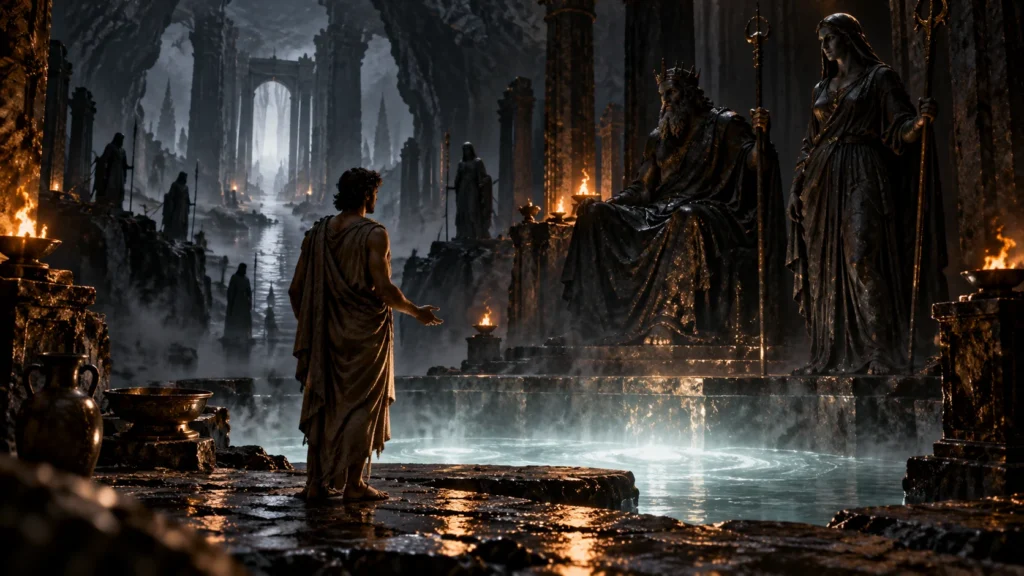
The water is only part of the journey. In several inscriptions the dead traveler must identify themselves. The Getty tablet dramatizes this as a short dialogue, asking the visitor about identity and origin. The response claims descent from Earth and starry Heaven and a heavenly lineage. [2]
Those words are not a modern password in the technological sense. They are a ritual formula within a religious text. They declare that the speaker belongs to a special category and knows the language appropriate to a particular passage through the Underworld. The manuscripts do not prove that literal guards waited for souls after death. They show that some ancient people prepared for that imagined encounter.
This changes the emotional stakes of the story. A person might possess wealth, descendants and public honors while alive. None of those things appears sufficient on its own in the inscription. What matters is remembering the correct relationship between the self and the sacred.
The idea connects unexpectedly with the ancient demand to examine one’s identity in Know Thyself in Ancient Greece. The contexts are different, so we should not claim one statement explains the other. But both challenge the assumption that knowing who you are is easy.
Were the Tablets Really Orphic?
You will often see these objects called Orphic gold tablets. That label is useful for finding them in books and museums, but it can imply more certainty than the evidence warrants. The Getty notes that the surviving texts do not name Orpheus. Ancient ritual traditions associated with Orpheus and Dionysus help explain why scholars study them together, but that does not settle the precise affiliation of every leaf. [2]
The debate is substantial rather than cosmetic. Alberto Bernabé and Ana Isabel Jiménez San Cristóbal describe competing interpretations of the leaves as Orphic, Pythagorean or linked with other traditions. They also distinguish inscriptions centered on Memory from examples naming deities such as Persephone. [5]
In a later study, Mark McClay emphasizes the relationship between these funerary verses and Greek performance traditions. The texts may reflect poetic formulas adapted to the needs of rites, burials and particular communities, rather than pages copied from one fixed book of instructions. [6]
That does not make the tablets less remarkable. It means the evidence points toward a changing world of religious practice, not a single secret organization with identical rules in every city.
Could Some Souls Hope for a Better Fate?
The answer is yes, at least in some surviving Greek texts. Certain gold leaves describe a privileged path for the deceased and imagine association with blessed beings or divine company. The details vary from inscription to inscription. They do not describe a reward automatically available to everyone who died. [2]
Nor did the idea of a better afterlife begin or end with these gold objects. Pindar’s Olympian 2 offers a selective vision of the dead that includes judgment and the Island of the Blessed. Modern scholarship shows that even within this single ode, justice and exceptional divine favor do not fit one simple admission rule. [7]
The contrast with Achilles is stark. In one literary vision, even legendary greatness offers little consolation. In other visions, certain people could look beyond death toward recognition, purification or a more hopeful destiny. Neither text cancels the other. They reveal a tradition that argued with itself about what human life meant.
This is why calling the ancient Greek Underworld either eternal torture or eternal happiness misses the point. The evidence refuses such a tidy answer.
What Was the River of Forgetfulness?
Memory and oblivion are not confined to the gold tablets. Near the end of Plato’s Republic, the Myth of Er imagines souls choosing their future lives and then crossing a plain of Forgetfulness. They drink from a river whose water makes them forget. Er himself does not drink, allowing him to remember and report the journey. [8]
Plato is telling a philosophical story, not transcribing the Petelia inscription. The account has its own purpose: choices, responsibility, recollection and the condition of the soul. We can compare its concern with forgetting to the gold leaves without pretending they describe an identical geography or ritual. [8]
Across these different works, memory becomes more than the ability to recite a name. It may preserve a connection with identity, experience or a special status claimed by the dead. For the living audience, it also raises an uncomfortable question. If everything you remembered disappeared, what would remain of you?
The Fear Hidden Inside the Instructions
A small object has left us with a surprisingly large problem. Its owner could take nothing of ordinary life into the grave except the things loved ones placed there. Yet someone arranged for words to accompany the dead person, words meant to be remembered or recognized on a journey that no survivor could verify.
We do not know whether every owner memorized the text, whether every inscription was intended to be read aloud or how consistently the instructions were interpreted. The tablets cannot tell us what actually happens after death. They can tell us that some Greeks cared enough about the possibility of a different fate to give that hope a physical form. [3][6]
Our Ancient Greek Warnings archive often asks what a myth was trying to prevent. Here the anxiety is more elemental. What if even death did not free you from the possibility of making a mistake?
What the Evidence Still Cannot Tell Us
The British Museum can identify Petelia, describe the inscription and date the Greek gold leaf. Scholars can compare it with other finds, ancient poems and philosophical accounts. But none of those sources lets us reconstruct a universal ceremony or prove that every ancient Greek imagined an examination at a spring. [1][5]
Perhaps the strangest thing about these texts is their combination of fragility and ambition. Gold this thin can be folded, damaged or lost. The inscriptions nevertheless reach toward something immeasurably larger: an imagined future where a person might still have a name, a history and a place among the blessed.
Achilles wanted his life back. Someone buried with a gold leaf seems to have hoped for a better kind of death. Between them lies no final answer, only a question that the ancient world left us in gold.
Frequently Asked Questions
What did ancient Greeks believe happened after death?
Many ancient Greeks imagined a realm of the dead associated with Hades. Beliefs differed across epic poetry, mystery traditions and philosophy. There was no single afterlife story accepted in all periods and communities.
Is Hades the same as Hell?
No. Hades is a Greek god and also the realm associated with the dead. It was not simply a place where all deceased people were punished.
What are the Orphic gold tablets?
They are small inscribed pieces of gold found in some ancient Greek burials. Some give directions or ritual formulas for the deceased. The word Orphic is a scholarly convention and their religious affiliations remain debated.
Where is the Petelia gold tablet today?
The tablet from ancient Petelia in southern Italy is held by the British Museum under registration number 1843,0724.3. The museum dates the Greek tablet to the third or second century BCE.
What was the Lake of Memory?
In some funerary gold inscriptions, the Lake of Memory is a source of water that the deceased is directed to find. Its ritual importance should not be confused with a universally agreed map of the Underworld.
Did every Greek receive secret instructions for the afterlife?
No. The gold leaves are rare and offer evidence for particular people and religious practices. They cannot establish a universal ancient Greek burial custom.
Was Lethe the river of forgetting?
In Greek traditions including Plato’s Myth of Er, forgetting is associated with a river or water in the next world. That does not mean every unnamed spring on a gold tablet can securely be identified as Lethe.
Sources and Notes
- [1] British Museum, Petelia gold tablet, museum object 1843,0724.3. Object record for findspot, dating, materials, case and Underworld directions.
- [2] J. Paul Getty Museum, David Saunders, “Golden Tickets to the Underworld” (2018). Museum account of its gold tablet, inscription variations and funerary uses.
- [3] Fritz Graf, “Gold Tablets,” Oxford Classical Dictionary (2017). Scholarly overview of the objects, dates and debated religious affiliations.
- [4] Homer, Odyssey, Book 11, Achilles in the Underworld. Primary literary source for Achilles’ response to Odysseus.
- [5] A. Bernabé and A. I. Jiménez San Cristóbal, “Are the ‘Orphic’ gold leaves Orphic?” in The Orphic Gold Tablets and Greek Religion (2011). Competing scholarly identifications and the problem of religious labels.
- [6] Mark McClay, The Bacchic Gold Tablets and Poetic Tradition: Epilogue (2023). Recent scholarship on poetic performance, ritual adaptation and burial contexts.
- [7] Journal of Hellenic Studies, “If one knows what is to come: ethics, audience and eschatology in Pindar’s Olympian 2” (2024). Modern analysis of Pindar’s varied presentation of blessed afterlives.
- [8] Plato, Republic, Book 10, 620d–621c, the Myth of Er. Primary text for the Plain of Forgetfulness and the river.