DELPHI · SOCRATES · SELF-KNOWLEDGE
“Know thyself” was an ancient Greek maxim associated with Apollo’s sanctuary at Delphi. In its early setting, it was not simply advice to discover your personality or become more authentic. One influential scholarly reading connects it with knowing human limits, understanding one’s place among other people and recognizing the distance between mortals and gods. Socrates did not invent the phrase, but Plato helped turn it into one of philosophy’s most difficult questions about self-knowledge. [1]
The Greek words were γνῶθι σεαυτόν, usually transliterated gnōthi seauton and often searched today as gnothi seauton. Two words survived for more than two thousand years because they sound simple, yet the difficulty begins as soon as we ask what kind of knowledge they demand. Modern readers tend to hear an invitation to look inward. Ancient Greeks approaching Delphi encountered something less comfortable.
What Does “Know Thyself” Mean?
The English translation is straightforward enough. Know thyself means know yourself. What counted as knowing yourself is where the history becomes complicated, because the phrase did not begin as a modern exercise in personality discovery.
Andrea Nightingale, writing on Plato and ancient models of mind, notes that self-knowledge in archaic and classical Greek thought could involve understanding oneself in relation to other humans and to the divine. The person who knew himself understood human limitations and did not cross boundaries as though mortal status no longer applied. [1] That is rather different from opening a notebook and listing your strengths.
At its sharpest, the idea asks whether you understand your measure. It asks where your power stops, where your knowledge stops and where confidence has begun pretending to be something more reliable than it is. We should still resist the temptation to turn that into a single official definition. No surviving ancient text labels one explanation as the original meaning of the Delphic words. What survives is a tradition, several ancient interpretations and later philosophical transformations. The uncertainty is part of the story.
Where Was “Know Thyself” Written?
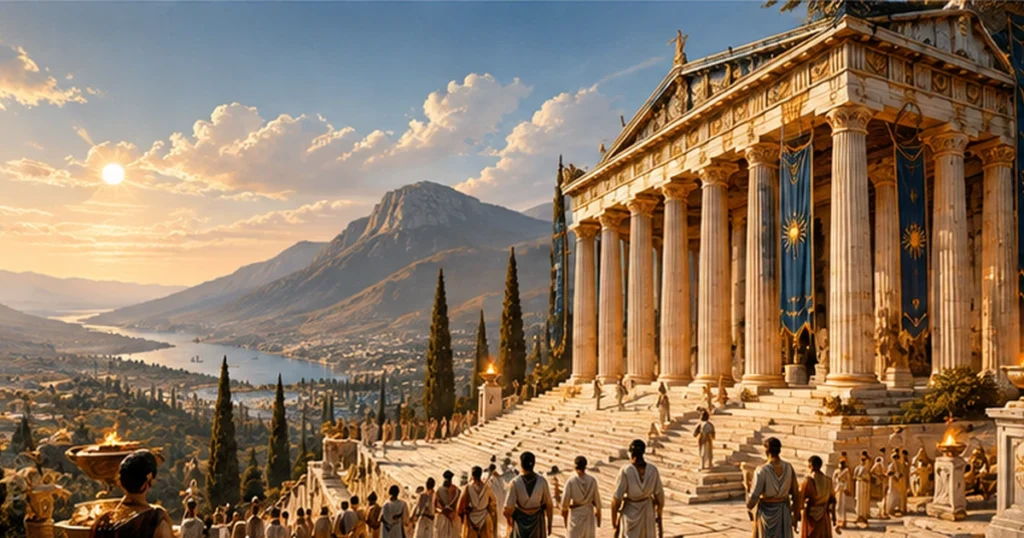
Ancient testimony places the maxim at Delphi, the sanctuary of Apollo on the slopes of Mount Parnassus. Pausanias, writing in the second century AD, says that useful maxims attributed to the Greek sages were written in the fore-temple and specifically names “Know thyself” and “Nothing in excess.” Plato had already linked those same sayings with Delphi centuries earlier in the Protagoras. [2][3]
The archaeological site of Delphi today follows that ancient testimony. Its official account of Apollo’s temple describes Delphic maxims on the vestibule walls, including “Know thyself” and “Avoid excess.” [4] The location changes the way the sentence feels, because people came to Delphi precisely when there were things they did not know.
Cities asked about war, colonists asked where to settle and individuals brought questions whose answers seemed to lie beyond ordinary human sight. In that environment stood a warning about self-knowledge, reminding every visitor to consider the person doing the asking. Perhaps the danger was not ignorance alone, but ignorance that had stopped recognizing itself.
Who Said “Know Thyself”?
The familiar story begins to break apart as soon as we ask who wrote the phrase. “Know thyself” is frequently attributed to Socrates, yet ancient evidence does not support the simple claim that Socrates invented it.
In Plato’s Protagoras, Socrates lists the Seven Sages and describes them as masters of short memorable sayings. He says they gathered and dedicated their wisdom to Apollo at Delphi, including “Know thyself” and “Nothing overmuch.” [3] Pausanias preserves essentially the same Delphic tradition and says the sages dedicated the celebrated maxims to Apollo. [2] Neither passage gives us a secure individual author.
Diogenes Laertius makes the problem wonderfully messy. He associates “Know thyself” with Thales but also records a tradition in which Antisthenes attributed it to the priestess Phemonoë and said Chilon later appropriated it. Diogenes immediately warns that sayings connected with the sages were reported differently and shifted from one supposed author to another. [5]
That is probably the most responsible place to leave the question. The saying was ancient, strongly associated with Delphi and connected by Greeks with the wisdom of the sages. The surviving evidence does not allow us to put one author’s signature beneath it with confidence.
Did Socrates Say “Know Thyself”?
Socrates did something more important than inventing the sentence. He made it difficult. Plato repeatedly connects Socratic inquiry with the Delphic demand for self-knowledge. By the time those dialogues shaped the later philosophical imagination, Socrates and “Know thyself” had become almost impossible to separate.
There is still a difference between using a maxim and creating it. Plato’s own Protagoras presents the phrase as inherited wisdom, which places Socrates in its philosophical afterlife rather than at its securely identifiable origin. [3] That distinction reveals what happened to the maxim. A Delphic tradition was placed in the hands of a man who could turn two words into a lifetime of interrogation.
Why “Know Thyself” and “Nothing in Excess” Belong Together
Ancient sources repeatedly place another maxim beside “Know thyself.” Plato names the sayings together, Pausanias does the same and the official Delphi account continues to present them as part of the temple tradition. [3][2][4]
Nothing in excess. Nothing too much.
Read together, the two sayings sharpen one another. Know yourself. Know when enough has become too much. That is not an ancient translation of the pair, but it captures why their proximity is so suggestive. A quality can be admirable and still lose proportion. Courage can become recklessness, confidence can stop listening, ambition can continue after circumstances change and loyalty can survive long enough to defend something that no longer deserves defending.
The Greeks did not need a modern personality framework to understand excess. Their mythology is crowded with people who do not lack strength so much as confidence in the strength they already possess. The failure often begins when a person can no longer see where the boundary moved. Seen that way, “Know thyself” and “Nothing in excess” do more than decorate the same temple tradition. Together they create a problem that remains difficult to answer. How do you know when the thing that usually serves you has gone too far?
What Did Socrates Make of the Delphic Maxim?
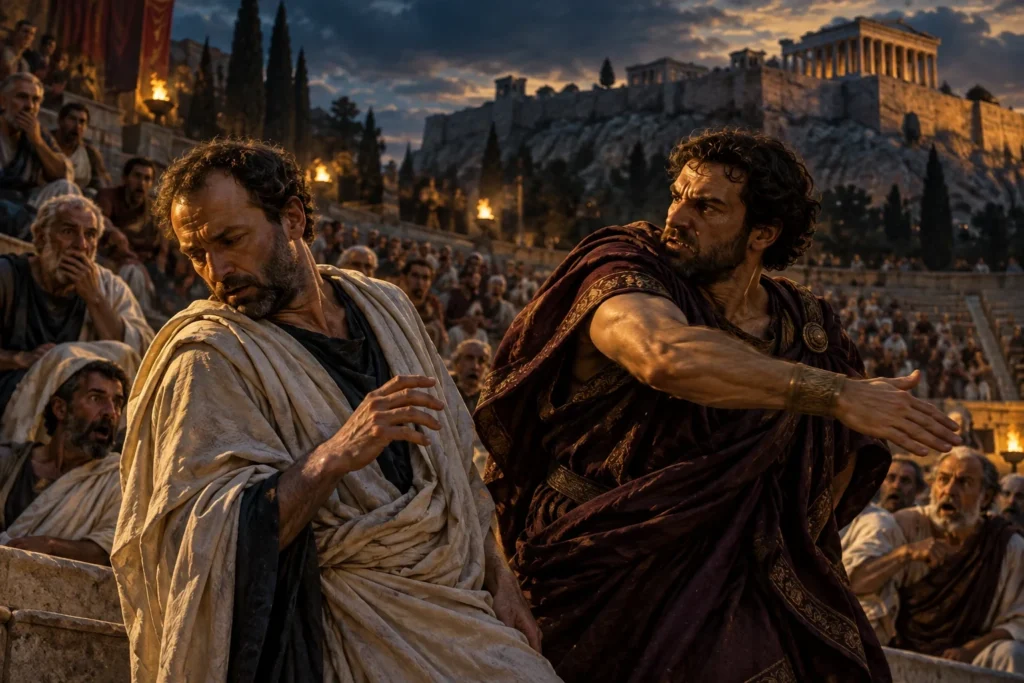
Plato gives us one of his strangest answers in the Phaedrus. Socrates and Phaedrus are outside Athens discussing myths attached to the landscape. The conversation touches on attempts to rationalize fabulous creatures and strange stories. Socrates says he has little time for that kind of work because he has not yet managed to obey the Delphic inscription and know himself.
Rather than spending his life explaining monsters, Socrates turns the investigation toward the creature conducting the investigation. He asks whether he might be something more complicated and furious than Typhon, the great adversary of Zeus, or whether he is instead a gentler and simpler being. [6] The joke carries a serious implication. Self-knowledge is no longer a collection of facts about preferences, skills or categories. Socrates is asking what kind of creature he is dealing with when he says “I.”
Plato does not immediately give him an answer, which may be the point. The Delphic command remains active because the person doing the examination cannot simply stand outside himself and inspect the evidence from a safe distance.
Plato Makes Self-Knowledge Harder
The Charmides complicates the phrase again. During an argument about sōphrosynē, usually translated with words such as temperance or moderation, Critias identifies self-knowledge with this virtue. He appeals directly to the Delphic inscription and suggests that “Know thyself” functions as the god’s greeting to those entering the sanctuary. [7]
The dialogue refuses to let the definition settle comfortably. The conversation moves toward the possibility of knowing what one knows and what one does not know, then tests even that formulation by asking what practical good such a knowledge of knowledge would provide. Modern scholarship has emphasized that Critias’s interpretation should not simply be equated with Socratic awareness of human limitation. Voula Tsouna argues that Critias presents a more confident and abstract model of self-knowledge, quite different from the recognition of the limits of human wisdom associated with Socratic inquiry. [8]
That disagreement is valuable because it prevents us from treating the maxim as a sentence with one philosophical definition waiting to be recovered. Plato inherits a famous saying and turns it into an argument.
Can You Know Facts About Yourself and Still Not Know Yourself?
Oedipus gives us a brutal way to understand the problem. Sophocles did not write Oedipus Tyrannus as an explanation of the Delphic maxim, yet philosophers have long found the tragedy useful because Oedipus discovers something terrifying about what self-knowledge can require. He already possesses pieces of the truth. Laius was killed, the child of Laius and Jocasta was marked by prophecy and Oedipus himself once fled the people he believed were his parents because of another prophecy. What he does not yet know is how those facts attach to him.
The Stanford Encyclopedia of Philosophy uses Oedipus precisely to illustrate this distinction. He can know propositions that concern Oedipus before recognizing that he himself is the person those propositions describe. [9] That is a harder form of ignorance than simply missing information. The evidence can be present, the investigator can be intelligent and the investigation can even be succeeding while the person searching for the truth still fails to recognize himself inside it.
This may be one of the darkest possibilities contained in the idea of self-knowledge. You do not always fail to know yourself because you know too little. Sometimes the facts are already there, but they have not yet broken through the story you believe about who you are.
How “Know Thyself” Changed from Delphi to Plato
There was no single moment when the maxim changed meaning. What we can see instead are layers. At Delphi, the saying belonged to a sanctuary tradition closely associated with measure, wisdom and human limitation. Ancient authors placed it alongside “Nothing in excess” while linking it with the sages. [2]
In Plato, the sentence becomes more inward and more philosophically dangerous. Socrates asks what kind of being he is, Critias tries to connect self-knowledge with temperance and the dialogues worry over whether knowing what you know and do not know is even possible in the way the argument seems to require. The ancient maxim survives, but the object called the self becomes harder to pin down.
That is one reason “Know thyself” has endured. The sentence is short enough to remember while the problem inside it refuses to stay solved.
What “Know Thyself” Does Not Mean
The maxim does not prove that ancient Greece possessed a modern personality system. It does not tell us that the Greeks divided everyone into fixed psychological types, turn Socrates into the inventor of personality testing or make every later theory of self-knowledge an ancient discovery waiting to be decoded. Famous ancient phrases attract modern systems very easily, which is exactly why the distinction matters.
A framework can be inspired by an ancient idea without being ancient itself. A modern interpretation can be useful without pretending that Plato, Delphi or the Seven Sages secretly designed it. The evidence becomes more interesting when we stop forcing it to validate ideas that came later. That principle also explains why I separate the historical sources from the modern framework in THE NINE. The ancient material should be allowed to remain ancient before we ask what we can build from it now.
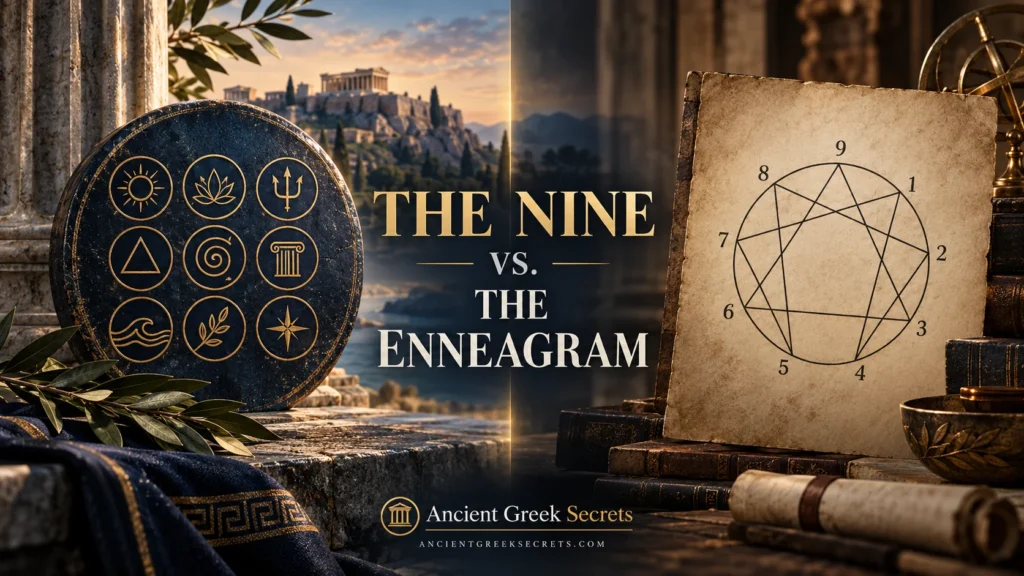
If you are interested in how that distinction works when comparing modern systems of self-knowledge, there is a fuller discussion in THE NINE vs. the Enneagram.
What the Delphic Maxim Still Asks
There is a reason the phrase survived while thousands of ancient sentences disappeared. It remains useful without becoming comforting. Know your abilities, but also know where they stop. Know your convictions, but ask what evidence could force them to change. Know the qualities that have carried you through difficult situations, but notice whether the situation in front of you is still the one those qualities learned to solve.
That last problem matters to me because self-knowledge becomes most difficult when the thing misleading us is not an obvious weakness. A weakness is often easier to suspect. A strength has a record. It has saved us before and earned our trust, which can make it unusually difficult to notice when the same strength is now producing the problem we are trying to solve.
Delphi offers no modern diagnostic tool for that problem. It offers something more austere and perhaps more demanding. Look again at the person who believes he knows.
From Ancient Maxim to Modern Framework
That question sits close to the starting point of THE NINE. The book asks what happens when a genuine human strength continues operating after the circumstances that once made it useful have changed. Its language of Gift, Shadow and Counterweight is modern. It is not presented as a recovered Greek personality system.
The separation is deliberate. Ancient philosophy, myth and number thought provide material to think with, while the framework built from that material belongs to the present. For me, that is the more interesting relationship between old ideas and modern life. We do not need to pretend the Greeks already invented our systems. We can allow them to challenge the assumptions from which we build them.
CONTINUE THE INVESTIGATION
See how the modern framework works in practice
Read one complete profile before deciding whether to go further, or explore the full framework inspired by ancient Greek thought.
Frequently Asked Questions
What does “Know thyself” mean?
“Know thyself” translates the Greek γνῶθι σεαυτόν. In ancient Greek contexts it could involve more than inward reflection, including awareness of human limitations, one’s relation to others and one’s proper position in relation to the divine. Plato later develops the maxim into more difficult philosophical questions about self-knowledge. [1]
Who said “Know thyself”?
There is no securely identifiable single author. Plato and Pausanias associate the maxim with the Seven Sages and Delphi while Diogenes Laertius preserves competing attributions involving Thales, Phemonoë and Chilon. [3][2][5]
Did Socrates invent “Know thyself”?
No ancient source we have examined presents Socrates as the inventor. Plato treats “Know thyself” as an already established Delphic maxim, although his depiction of Socrates helped make the phrase central to later philosophical ideas of self-examination. [3]
What is “Know thyself” in ancient Greek?
The familiar Greek form is γνῶθι σεαυτόν, transliterated gnōthi seauton. Modern searches often spell it gnothi seauton without the macron, but both point toward the same famous Delphic expression.
Where was “Know thyself” written?
Pausanias says the maxim was written in the fore-temple at Delphi and associates it with the sages. The modern archaeological site of Delphi likewise describes “Know thyself” among the maxims traditionally located on the vestibule walls of Apollo’s temple. [2][4]
Sources and Notes
- [1] Andrea Nightingale, “Plato on aporia and self-knowledge,” in Ancient Models of Mind. Nightingale discusses early Greek self-knowledge in relation to human limitation and Plato’s transformation of the concept.
- [2] Pausanias, Description of Greece 10.24.1. Pausanias reports the Delphic maxims and attributes their dedication to the sages.
- [3] Plato, Protagoras 343a–b. Plato associates the Seven Sages with Delphi and names “Know thyself” alongside “Nothing overmuch.”
- [4] Archaeological Site of Delphi, “Temple of Apollo.” The official site describes the Delphic maxims traditionally inscribed in the temple vestibule.
- [5] Diogenes Laertius, Lives of Eminent Philosophers 1.40–41. The work preserves competing traditions concerning authorship and warns that sayings of the sages were variously attributed.
- [6] Plato, Phaedrus 229e–230a. Socrates invokes the Delphic command before turning from mythological explanation toward the investigation of himself and comparing his nature with Typhon.
- [7] Plato, Charmides 164d onward. Critias interprets self-knowledge through the Delphic inscription and connects it with temperance.
- [8] Voula Tsouna, Plato’s Charmides. Tsouna distinguishes Critias’s account of self-knowledge from Socratic recognition of the limits of human wisdom.
- [9] Stanford Encyclopedia of Philosophy, “Self-Consciousness.” The discussion of Oedipus illustrates the distinction between knowing facts that concern oneself and recognizing oneself as their subject.