A SOURCE-GROUNDED COMPARISON
Put THE NINE beside the Enneagram and the resemblance seems obvious. Both organize self-reflection around nine positions. Each describes recurring strengths and recurring difficulties. In both cases, readers are asked to notice patterns that can become costly when they operate without enough awareness.
That resemblance is real. It is also where the easy comparison ends.
One point of orientation matters before the comparison goes any further. THE NINE is both the title of my book and the name of the modern framework developed in its pages. My framework draws on ancient Greek numerical thought and later traditions but keeps those historical layers separate from the modern psychological interpretation I develop from them.
Curiously, the number nine may be the least interesting thing these systems have in common.
The harder question is what happens when the system’s first explanation stops fitting you.
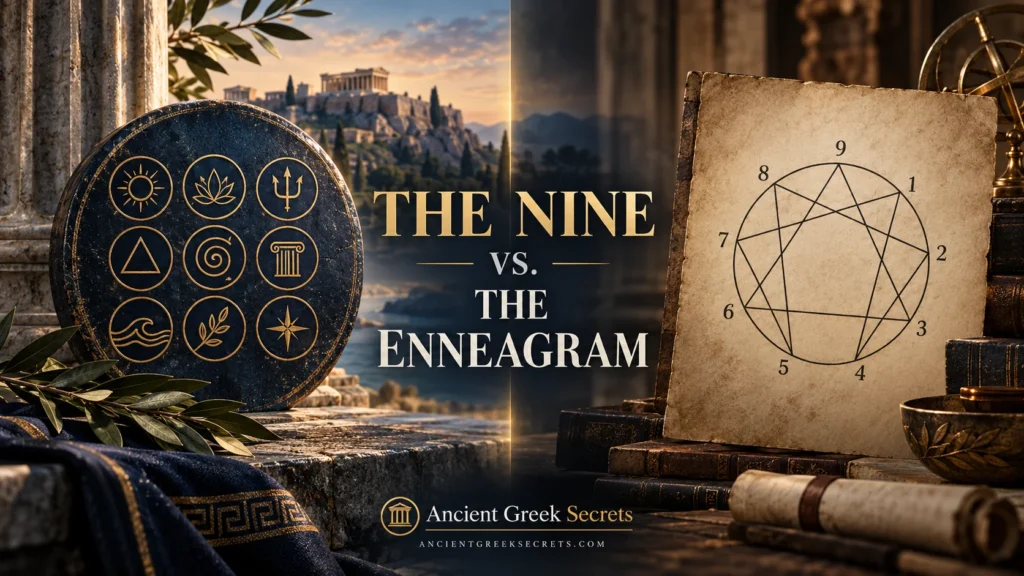
THE NINE vs. the Enneagram: the short answer
The Enneagram is a system of nine interrelated personality types. In the Riso-Hudson tradition, one type remains the person’s basic type while wings, Levels of Development, instincts and movement along connecting lines describe variation, growth and stress. The basic type remains the organizing center while other parts of the Enneagram help explain how that type changes or expresses itself under different conditions. [1][2]
THE NINE begins somewhere else. It uses a Timeless Number from One through Nine as an entry point into nine human capacities: Identity, Relation, Synthesis, Structure, Adaptation, Stewardship, Judgment, Agency and Resolution. Each capacity has a Gift, a Shadow that can emerge when that Gift is overextended and a Counterweight that restores something the original response has stopped including. The Timeless Number tells the reader where to begin. It does not claim the right to explain everything that follows. [7][8][9]
Keep that distinction in view.
In the Enneagram model examined here, the central question is often: Which type is my basic type and how is that type moving?
In THE NINE, the question eventually becomes: Which human capacity is actually operating here and does it still fit the problem?
The systems can therefore look similar from a distance while asking different questions once the reader begins using them.
What the Enneagram actually says
A fair comparison has to begin by resisting the weakest version of the Enneagram.
It is not simply a nine-box personality quiz.
The International Enneagram Association describes the Enneagram as a psychological and spiritual framework organized around nine distinct but interrelated personality types. Each type maps recurring patterns of thinking, feeling and behavior. The system is intended for self-understanding and development rather than merely assigning a label. [2]
The Enneagram Institute’s Riso-Hudson model adds an important qualification. It teaches that one of the nine types is the person’s basic personality type. That type does not change into another basic type. But the person is not treated as psychologically frozen. A wing can alter the expression of the basic type. Levels of Development describe healthier, average and less healthy expressions. Instincts add another layer. Connecting lines describe movement associated with growth and stress. The same source eventually describes the long-term aim as becoming able to draw on healthy potentials represented throughout the system. [1]
Calling the Enneagram a permanent nine-box system misses its own architecture. Its major traditions already contain mechanisms for movement.
There is, however, a smaller detail in the Enneagram Institute’s own explanation that becomes unusually important when comparing it with THE NINE. The Institute says the numbers are used because they are value neutral. It also says their numerical ranking is not significant. A Nine is not “more” than a Two because nine is larger than two. [1]
At first that may sound trivial. It stops being trivial when we ask what a number is supposed to mean.
Inside this Enneagram model, the number primarily locates a personality type without praising or condemning it. In practice, it functions as a clean label inside a larger diagram.
THE NINE asks the number to carry a different burden.
What THE NINE actually says
THE NINE also has nine archetypal profiles but it does not begin by claiming that nine kinds of people exist.
It begins with nine human capacities.
Gift, Shadow and Counterweight
Identity can become Self-Possession and then harden into Self-Enclosure. Relation can become Attunement and then collapse into Comparison. Judgment can become Discernment and then continue into Overanalysis. Each profile follows the same structural problem: a response can be genuinely useful under one set of conditions and become costly when it continues after those conditions have changed.
I call that movement the Gift-to-Shadow mechanism.
The Counterweight enters only when something important has dropped out of the response. It does not replace the original archetype. It supplies a missing capacity so the original Gift has another chance to become useful. THE NINE also audits the correction itself because a Counterweight can be pushed too far. [7][8]
A starting point, not a verdict
The reader reaches the framework through a Timeless Number calculated from a complete Gregorian birth date reduced to a final value from One through Nine. That method is modern. I do not claim in THE NINE that Pythagoras or other ancient Greeks used this birth-date procedure and I do not treat the resulting number as psychological evidence. Ancient Greek material supplies historical anchors, mathematical structures and later symbolic traditions. What follows from those sources is a modern psychological architecture. [9]
That distinction limits the authority of the result.
Your Timeless Number tells you where to start reading. It does not get the final word.
In the later chapters of THE NINE, the framework becomes deliberately vulnerable to contradiction. A description feeling accurate is not treated as proof. Evidence that does not fit must still count. Another archetypal mechanism is allowed to explain a particular situation better than the reader’s Timeless Number. Some experiences may not fit THE NINE usefully at all. [7][8]
I consider that one of the most important rules in the framework because any system of self-knowledge faces the same temptation. Once a description feels like us, we can start using the description to protect itself.
THE NINE is designed to resist that move.
A Timeless Number opens a door. Reality is allowed to tell you that you walked into the wrong room.
THE NINE vs. the Enneagram at a glance
At this point the similarities and differences can be stated plainly.
| Question | Enneagram | THE NINE |
|---|---|---|
| What is being organized? | Nine interrelated personality types | Nine human capacities or archetypal forces |
| What does the number do? | Primarily labels and locates a personality type within the system | Serves as an interpretive starting point tied to a Core Force |
| Is there one central identity? | In major modern schools, one basic type remains the central type | The Timeless Number is a starting lens, not a complete identity |
| How does change happen? | Through features such as wings, Levels of Development, instincts and movement along connecting lines | Through Gift → Shadow → Counterweight → renewed use of the original Gift |
| Can another number become important? | Yes, through wings, line movement and other system features while the basic type remains central | Yes. Another archetypal mechanism may explain the present problem better than the Timeless Number |
| What happens when the first explanation does not fit? | A reader may reconsider the type or interpret the situation through the wider Enneagram architecture | Contradictory evidence is allowed to count against the starting interpretation |
| What historical claim is being made? | A modern personality system built around an older symbol whose earlier lineage is described differently across traditions | A modern interpretive framework inspired by ancient Greek numerical evidence and later traditions |
| What is the scientific status? | An empirical literature exists but the evidence is mixed | It is not presented as a validated personality assessment |
The table makes one thing clear immediately. The two systems are not separated by whether they allow complexity. Both do.
They differ more sharply in where that complexity is permitted to challenge the starting identity.
Type vs. starting lens
The Enneagram Institute says that one of the nine types is the person’s basic personality type. It also says people do not change from one basic type to another. Variation enters through wings, Levels of Development, instincts and the two connecting lines associated with growth and stress. Its own description therefore gives the system both continuity and movement. The basic type remains while expression changes. [1]
THE NINE does not give the Timeless Number the same authority.
Chapter 11 of THE NINE calls the result an entry point rather than a complete psychological inventory. Chapter 21 of THE NINE goes further. The Nine are described as human capacities rather than nine sealed kinds of people. A person’s Timeless Number may reveal a recurring strategy quickly but it does not receive permanent jurisdiction over every situation. [8][9]
The difference becomes visible when a real problem refuses to cooperate with the label.
When another mechanism explains the problem better
Imagine that your Timeless Number is Seven, The Observer. You recognize Independent Judgment easily and you know the danger of Overanalysis. Then your family begins depending on you for every appointment, every reminder and every unfinished responsibility. You become exhausted but you keep carrying the load because things fall apart when you stop.
THE NINE does not require that problem to remain a Seven problem.
The active mechanism may be Six: Stewardship becoming Overfunctioning. If Six explains the situation better, Six becomes the useful lens even though Seven remains the Timeless Number. The framework changes the question from “How is my number expressing itself?” to “What capacity is actually operating here?” [8]
For me, this is the distinction worth protecting most carefully.
The Enneagram model examined here preserves a basic type while allowing other parts of the architecture to influence its expression. THE NINE preserves a starting number while allowing the active mechanism in a specific situation to move elsewhere entirely.
One system gives identity more continuity. The other gives interpretation more freedom to migrate.
Neither approach is automatically better. They solve different problems.
What happens when the first explanation stops fitting?
A feature list cannot capture the next difference.
Every system of self-knowledge faces a danger once the reader recognizes themselves in it. Recognition feels like confirmation. Confirmation encourages selective attention. Before long the framework can start explaining the evidence it helped the reader notice.
THE NINE makes that risk explicit.
Chapter 21 of THE NINE warns that a reader can begin seeing the Timeless Number everywhere. A One can reinterpret every disagreement as a boundary problem. For a Four, every difficulty can start looking like a structure problem. A Seven can turn every uncertainty into another reason for investigation. At that point the framework begins generating its own proof. [8]
The safeguard is unusually direct: a useful interpretation must remain vulnerable to evidence that counts against it.
If another mechanism explains the situation better, the framework is supposed to make room for that mechanism rather than defend the original label. If the interpretation does not survive contact with reality, the label does not get to win by default. [8]
What reality is allowed to overturn
Once that safeguard is in place, the number plays a different role.
The Timeless Number still matters. It gives the reader a stable place to enter the architecture. It identifies a Gift that may be especially easy to recognize and a Shadow worth watching. But it cannot demand that every later experience become evidence for itself.
For me, the more revealing question is not simply “Which system has more moving parts?”
The better question is:
What is each system willing to let reality overturn?
In the Riso-Hudson Enneagram, a reader can mistype and reconsider the original type. Once the basic type is established, however, the architecture interprets change through that persistent type, its wing, its Levels, its instincts and its lines. [1]
In THE NINE, the starting number may remain useful while the active explanation of a particular problem shifts to another archetype. The system is therefore less interested in protecting one identity label across every context. It is more interested in whether the current mechanism still explains what is happening. [8][9]
I am not using falsification in the technical scientific sense here. This is a design rule against self-sealing interpretation.
The framework is allowed to lose an argument with the person using it.
Counterweights are not Enneagram integration lines
Counterweights invite the most tempting one-to-one comparison and one of the easiest to get wrong.
The Enneagram Institute describes two connecting lines for each type. In its Riso-Hudson model, one line represents a direction associated with integration or growth while the other represents a direction associated with stress or disintegration. A person’s basic type remains the organizing type as other type-patterns become relevant under different conditions. [1]
A Counterweight in THE NINE works differently.
It does not represent where a person is headed as they become healthier. It is not a second type and it is not another identity waiting underneath the first one.
A Counterweight becomes useful only when a Gift has moved into its Shadow and the response has stopped including something the present situation requires. Four’s Reliability may need Six’s Purpose Stewardship when structure has begun serving itself. Seven’s Independent Judgment may need Three’s Provisional Synthesis when investigation has stopped changing the conclusion. Eight’s Strategic Agency may need Two’s Personhood Recognition when efficiency has begun reducing people to functions. [8]
The person does not become the Counterweight.
The Counterweight supplies a missing capability then returns authority to the original Gift.
When the correction goes too far
There is another difference that matters even more: THE NINE does not assume the correction is automatically correct.
A Counterweight can be activated and still leave the original decision intact. Four may ask what living need a rule serves and conclude that the rule should remain exactly as it is. Seven may test whether more evidence could realistically change the conclusion and discover that more investigation is still warranted. The correction exists to widen the evidence rather than force reversal. [8]
But correction can also go too far.
That second check matters because the original Gift can become a Shadow but the borrowed corrective capacity can become excessive as well. THE NINE therefore audits both the strength and the correction.
For that reason, I would not describe Counterweights as “THE NINE’s integration lines.”
The visual resemblance is easy to see. One number draws on another. The psychological logic is different.
The Enneagram’s connecting lines describe movement within a personality architecture centered on a basic type. Counterweights are situational corrective tools inside a framework that already assumes the active mechanism may not be the reader’s Timeless Number.
One describes movement around identity.
The other is designed to recover information a trusted response has stopped seeing.
Subtle as it is, the distinction changes how the system is used.
Is the Enneagram ancient? First decide which Enneagram you mean
The history of the Enneagram becomes confusing very quickly because the same word can refer to several different things.
The term can refer to the Greek-derived name, the nine-pointed symbol taught by George Gurdjieff or Oscar Ichazo’s arrangement of passions, fixations and related categories around that figure. It can also refer to Claudio Naranjo’s later psychological elaboration of personality types or to the modern system now taught through schools that have developed their own vocabularies and emphases.
Those are not the same historical claim.
Arguments about whether the Enneagram is “ancient” often slide between those layers.
A Greek name does not prove a Greek system
The name itself is Greek in formation. Ennea means nine and gramma or related forms refer to something written or drawn. Greek vocabulary, however, does not establish an ancient Greek personality system. A modern system can have a Greek-derived name without having been practiced in classical Greece. [3][4]
The symbol has a different history.
George Gurdjieff taught the Enneagram figure in the early twentieth century as part of his esoteric system. Independent historian of religion Carole Cusack describes Gurdjieff’s Enneagram as a symbol expressing processes through his Laws of Three and Seven. Her study also notes that Christian, Sufi, Kabbalistic and other origins have been proposed for the figure. Those proposed ancestries are not the same thing as a documented chain of transmission. [5]
Where the modern personality system enters
The history gets more revealing here.
The Enneagram Institute says Gurdjieff did not teach the modern nine personality types. It goes further. It calls the belief that the nine-type system was handed down intact through a Sufi or other ancient oral tradition “widespread and erroneous.” In its account, Oscar Ichazo is the person who assembled the personality system in the 1960s by connecting several traditions to the Enneagram symbol. [3]
The Narrative Enneagram tells the story with a different emphasis. It says the Enneagram was “borne out of ancient tradition” then identifies a modern sequence: Gurdjieff introduced the system to the modern world, Ichazo placed nine personality types around the diagram in the late 1960s and Claudio Naranjo plus other psychologists developed it into a modern psychological system from the 1970s onward. [4]
Those two institutional histories are not identical.
They do agree on something important: the personality Enneagram familiar to contemporary readers took shape in the twentieth century.
Independent scholarship makes the same chronological distinction from another direction. Cusack treats Gurdjieff’s Enneagram as an esoteric process symbol and describes the later personality-analysis tradition as post-Gurdjieffian with a major debt to Ichazo. [5]
A better answer sits between the two extremes.
The modern personality Enneagram was not simply found intact in ancient Greece. Nor does the evidence require us to pretend that every idea surrounding the symbol began in one moment in the 1960s.
Different schools claim older religious, philosophical and esoteric ancestry. Gurdjieff supplied the twentieth-century symbol in this story. Ichazo added the decisive personality application. Naranjo supplied a psychological elaboration then later schools systematized and popularized different versions of the model.
The mistake is collapsing all of those layers into one age.
Why this matters for THE NINE
THE NINE faces a similar temptation from the opposite direction.
Its ancient material is genuinely ancient. Euclid really does distinguish unit from number. Aristotle really does report Pythagorean numerical doctrines. Later Greek-language sources really do preserve arithmological symbolism and forms of numerical reduction.
None of that proves that ancient Greeks possessed THE NINE’s finished psychological architecture.
I say so explicitly in the book.
Its complete Gregorian birth-date reduction is modern. The research for the book did not identify an ancient Greek procedure that reduces a person’s complete birth date to the Timeless Number used here. Ancient birth divination existed but its mechanisms could be astrological and astronomical rather than digital reduction. Late ancient Greek-language material does preserve other reduction procedures including roots from One through Nine but that is evidence for numerical practice, not for THE NINE’s modern personality framework. [9][10]
I would rather state that boundary plainly than hide it.
It is the line that keeps inspiration from turning into invented pedigree.
I think both systems become more interesting when we stop asking them to be older than the evidence allows.
The historical question should not be, “Can we push this system as far back as possible?”
It should be:
Which parts are ancient, which parts are later and which parts are modern acts of interpretation?
The result is more useful than a pedigree. It gives the reader a map of where the evidence changes status.
Is the Enneagram scientifically valid?
The science question also needs unpacking.
“Does the Enneagram work?” can mean several different things.
Does a questionnaire produce reliable scores? Can nine distinct personality types be recovered from data? Do Enneagram scores relate to established personality constructs? Might people find the framework useful for reflection? Are wings or movement between types empirically supported?
Those questions require different evidence.
What the 2021 review actually found
The strongest broad review located for this article is a 2021 systematic review in the Journal of Clinical Psychology by Joshua Hook and colleagues. The authors reviewed 104 independent samples and concluded that the evidence for Enneagram reliability and validity was mixed. [6]
Mixed evidence is not no evidence.
The review found some factor-analytic results that partially aligned with Enneagram theory. Some subscales showed theory-consistent relationships with constructs such as the Big Five. Several studies also reported that people found the Enneagram useful for personal or spiritual growth. [6]
But the limitations matter just as much.
Factor analyses typically recovered fewer than nine factors. The review found no work using clustering techniques to derive the nine types from the data and it found little research supporting secondary parts of Enneagram theory such as wings and intertype movement. [6]
The review forces three different claims apart:
- People can find a framework useful.
- Some measures associated with the framework can correlate with established psychological constructs.
- The framework’s complete theoretical architecture has been empirically demonstrated.
Those are not interchangeable claims.
The systematic review gives some support to the first two while leaving substantial questions around the third. [6]
I think that distinction is more useful than attaching a one-word verdict such as “scientific” or “pseudoscientific” and ending the conversation there.
A reflective framework can generate useful language without proving that nature contains exactly nine discrete personality types. A person can gain something from a question without the question becoming a validated diagnostic instrument.
Usefulness is not validation
The reverse caution matters too.
A description can feel clarifying. Workshops can produce insight. Someone can make a better decision after encountering a framework. None of those experiences by themselves demonstrate that the framework’s underlying personality structure is scientifically true.
THE NINE has to meet the same standard.
What science can and cannot say about THE NINE
THE NINE should not borrow scientific credibility from the Enneagram merely because both systems use nine.
It should not borrow scientific credibility from the ancient Greeks merely because some of its source material is ancient either.
Historical sourcing answers historical questions. It can establish that an ancient author said something or that a numerical structure existed. It cannot validate a modern psychological interpretation built from that material.
I draw that boundary explicitly in THE NINE. It is not a scientific personality assessment. Its Timeless Number is not presented as proof that a birth date causes a personality structure. The full Gregorian birth-date calculation is a modern entry mechanism into the framework rather than a scientifically established psychological measurement. [9]
At present, THE NINE does not have a body of psychometric research showing reliability, factor structure, predictive validity or diagnostic validity.
I want that stated in the open, not buried in fine print.
If we are going to criticize exaggerated claims made for another system, ours has to survive the same standard.
What THE NINE can responsibly claim
There is also a subtler point.
The absence of psychometric validation does not tell us that every reflection produced by THE NINE is false. It tells us what kind of claim we are entitled to make.
We can say that THE NINE is a source-grounded interpretive framework.
It was designed to make strengths, excesses and missing capacities easier to examine.
The framework deliberately treats recognition as a starting point rather than proof and asks contradictory evidence to count against an interpretation. The book grounds that caution in research on personal validation and confirmation bias. [8]
What we cannot say is that a Timeless Number scientifically identifies personality.
Nor can we claim that the nine archetypes have been discovered as nine latent psychological types in population data.
Counterweights also have not been clinically validated as a treatment mechanism.
Those claims would require research that does not currently exist.
A fairer scientific comparison
So where does that leave the comparison?
The Enneagram has been studied empirically for decades. That is a strength compared with a new framework because there is evidence to examine. The result is not a clean scientific endorsement. Hook and colleagues found mixed reliability and validity with partial support in some areas and major gaps in others. [6]
THE NINE is newer and has no comparable psychometric literature. I therefore make a narrower claim for it: it is an interpretive framework informed by source criticism, ancient numerical thought and modern psychological analogies rather than a validated personality assessment. [9]
Science gives neither system an easy victory.
The Enneagram cannot turn longevity, popularity or personal recognition into proof of its full nine-type architecture.
THE NINE cannot turn historical scholarship, philosophical coherence or a reader’s recognition into psychometric validation.
I prefer that symmetry.
It keeps the article from using science as a weapon only when it points at the other system.
And it brings us back to the deeper standard running through this comparison:
A self-knowledge framework should be clear not only about what it sees but about what kind of evidence could prove that it is seeing too much.
It is a harder standard than sounding accurate.
It is also a more useful one.
Can you use THE NINE and the Enneagram together?
Yes, if you keep the systems in their proper roles.
There is no need to treat them as rivals competing for the right to explain an entire person.
If you already know your Enneagram type and find that language useful, THE NINE does not require you to discard it. They can sit beside one another because they organize attention differently.
The Enneagram can give you a stable vocabulary for recurring personality patterns. THE NINE can ask a more situational question: which human capacity is operating here and has that capacity begun to create a cost?
Those questions can coexist.
What does not work well is forcing them into a conversion chart.
An Enneagram One is not automatically THE NINE’s Origin. A Seven is not automatically The Observer. Shared numbers create a visual temptation but the systems assign different meanings to those numbers and use them for different purposes.
The safest approach is to let each framework make its own claim.
If both point toward the same pattern, that convergence may be worth examining.
If they disagree, the disagreement may be even more useful because it forces you to ask what evidence each interpretation is actually using.
A framework becomes less helpful when preserving the framework matters more than understanding the person.
Who THE NINE is for
THE NINE will not appeal equally to every reader.
It is probably a good fit if you want a framework that begins with a number but refuses to let that number become a verdict.
Readers interested in ancient Greek thought may also appreciate seeing the historical evidence separated from later symbolism and modern psychological interpretation rather than blended into one seamless tradition.
The framework is especially suited to readers who are less interested in discovering one final answer to “What type am I?” and more interested in questions such as:
- What strength am I relying on here?
- When did that strength stop helping?
- What has the response begun to exclude?
- Which missing capacity would widen the situation?
- What evidence would make me change my interpretation?
That last question matters to me.
The attraction of any self-knowledge system is that it can make experience feel suddenly legible. But legibility can become certainty before it has earned the right.
THE NINE was designed to keep that door open.
It gives the reader a place to begin then asks reality to keep participating in the interpretation.
Read one complete profile before deciding
The easiest way to understand the difference is not to read another description of THE NINE.
It is to use one complete profile.
We have made The Origin, the Number One profile from Chapter 12, available to read free on Ancient Greek Secrets.
The sample includes the full architecture:
- Core Force
- Gift
- Shadow
- Mythic Mirror
- Counterweight
- corrective question
- Counterweight limits
- practice
- Timeless Warning
The sample is the complete profile rather than a shortened teaser.
The complete profile matters because the framework should be judged on the full movement from strength to excess to correction rather than on a short archetype description.
Start with the free profile. If the framework still interests you afterward, you can explore the complete book here:
Frequently asked questions
Is THE NINE based on the Enneagram?
No.
I developed THE NINE from a different research path centered on ancient Greek numerical thought, later arithmological traditions and a modern framework of nine human capacities. Its Gift, Shadow and Counterweight architecture is not derived from Enneagram types, wings or integration lines.
The superficial resemblance is obvious because both use nine. The underlying structures are different.
Is THE NINE a personality test?
No.
THE NINE is not presented as a validated personality assessment and the Timeless Number is not treated as a complete psychological inventory.
Your number gives you a starting point. From there, the framework asks whether the pattern actually helps explain lived experience.
Is the Enneagram ancient Greek?
Not in the sense of a documented ancient Greek nine-type personality system.
The name is Greek in formation but the personality system familiar to contemporary readers took shape in the twentieth century through figures including Gurdjieff, Oscar Ichazo and Claudio Naranjo. Claims about older philosophical, religious and esoteric lineages vary by tradition.
Is THE NINE numerology?
It uses a numerical reduction of the complete Gregorian birth date as its entry method so avoiding the comparison entirely would be misleading.
What matters is the authority that number receives.
THE NINE does not claim that the birth date causes personality, predicts events or proves identity. In the book, the calculation is explicitly treated as a modern method for choosing where reflection begins.
So the framework uses numerical reduction but does not ask the result to function as destiny.
Can I use THE NINE if I already know my Enneagram type?
Yes.
You do not need to replace one system with the other.
The useful question is whether each framework helps you notice something the other does not. Avoid one-to-one number matching and let each system preserve its own architecture.
Does my Timeless Number define my personality?
No.
Your Timeless Number is a starting lens.
THE NINE explicitly allows another archetypal mechanism to become more relevant in a specific situation and it requires contradictory evidence to count against an interpretation.
If the number stops helping you understand what is happening, the framework is not supposed to force reality back into the label.
Is either system scientifically proven?
No.
The Enneagram has an empirical research literature but the evidence is mixed and important parts of the theory remain under-supported. THE NINE is newer and is not presented as a psychometrically validated personality assessment. Neither system should be treated as a clinical diagnosis.
The difference I keep coming back to
Two systems can both contain nine positions and still disagree about what self-knowledge requires.
The Enneagram asks the reader to discover a basic type then understand how that type expresses itself through a larger architecture.
THE NINE gives the reader a starting number then keeps asking whether the active mechanism still fits the evidence.
What can be easy to miss is how much that difference changes the use of the framework because the diagrams and labels attract attention first.
But classification is only the beginning.
The harder test comes later.
What does the framework do when you stop behaving like its first explanation of you?
Does it reinterpret everything until the label survives?
Can the interpretation move?
What kind of evidence should count against the pattern?
Those questions matter more to me than whether two systems happen to share the number nine.
A useful framework should help you recognize yourself.
A trustworthy one should also leave room for you to surprise it.
Sources and notes
- [1] The Enneagram Institute, “How the Enneagram System Works.”
- [2] International Enneagram Association, “The Enneagram.”
- [3] The Enneagram Institute, “Traditional Enneagram (History).”
- [4] The Narrative Enneagram, “Our Story.”
- [5] Carole M. Cusack, “The Enneagram: G.I. Gurdjieff’s Esoteric Symbol,” Aries 20, no. 1 (2020): 31–54.
- [6] Joshua N. Hook, Todd W. Hall, Don E. Davis, Daryl R. Van Tongeren and Mackenzie Conner, “The Enneagram: A Systematic Review of the Literature and Directions for Future Research,” Journal of Clinical Psychology 77, no. 4 (2021): 865–883.
- [7] Nikolaos Vale, THE NINE: A Modern Framework Inspired by Ancient Greek Thought. See the Introduction and Sources & Notes for the distinction between ancient evidence, later tradition and modern interpretation.
- [8] Vale, THE NINE, Chapter 21, “Living with the Nine,” and its Sources & Notes. See especially the discussion of recognition, confirmation bias, situational mechanisms and Counterweights.
- [9] Vale, THE NINE, Chapter 11, “The Timeless Number,” and its Sources & Notes. See the modern birth-date method, entry-point rule and historical guardrails.
- [10] Vale, THE NINE, Chapter 11 Sources & Notes. See the distinction between ancient birth divination, late ancient numerical reduction and the modern calculation used in the book.