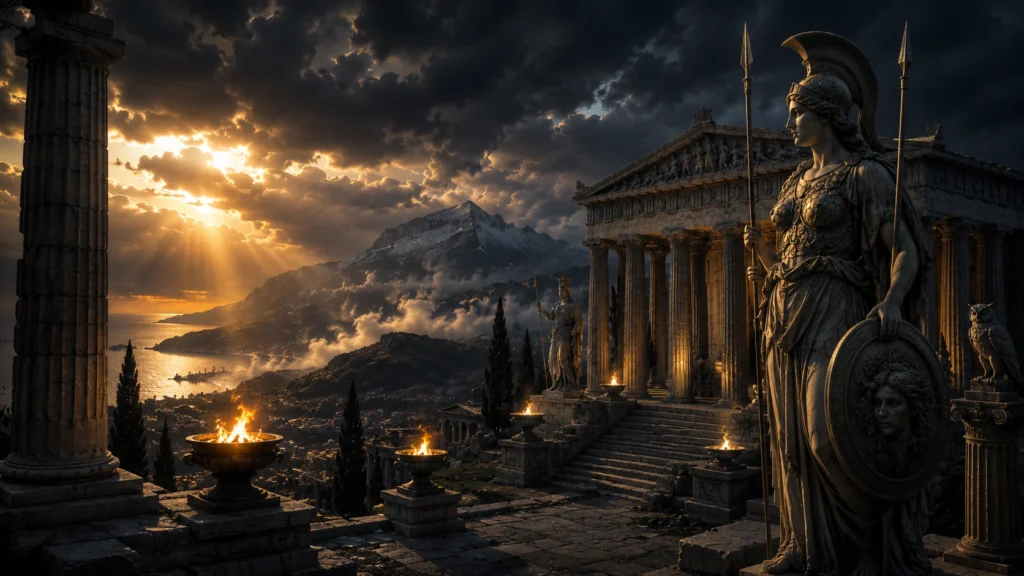
For almost three thousand years, people have remembered The Odyssey for its monsters.
A one-eyed Cyclops. Sirens whose voices draw sailors toward destruction. A sorceress who transforms men. A sea monster waiting between impossible choices. A goddess who offers a hero a life outside ordinary human limits.
But the monsters may be the easiest part of Homer’s story to remember.
The harder question is why Odysseus keeps encountering them.
The Odyssey is not simply an ancient adventure story about a Greek king trying to sail home. It is a story about what happens when intelligence meets pride, hunger overwhelms judgment, comfort becomes captivity and victory fails to bring peace.
Odysseus survives Troy.
Then the real test begins.
The epic has returned to global attention through Christopher Nolan’s 2026 adaptation of The Odyssey. Yet the story audiences are rediscovering is far stranger than a sequence of cinematic adventures.
Behind the Cyclops, Sirens, Circe, Calypso and the voyage to Ithaca lies something darker.
A warning system.
What Is The Odyssey About?
The Odyssey is an ancient Greek epic poem traditionally attributed to Homer.
It follows Odysseus, king of Ithaca, after the Trojan War. The war itself has already lasted ten years. Odysseus then spends another ten years trying to return to his homeland, his wife Penelope and his son Telemachus.
That description sounds simple.
The poem is not.
Homer does not even begin at the beginning. When The Odyssey opens, Odysseus has already been absent from Ithaca for twenty years.
Penelope is surrounded by suitors who consume the resources of his household.
Telemachus has grown up without his father.
Odysseus is stranded with Calypso.
Athena is trying to bring the broken household back together.
Only later does Odysseus recount many of the adventures for which the epic became famous: the Lotus-Eaters, Polyphemus the Cyclops, Aeolus, the Laestrygonians, Circe, the Underworld, the Sirens, Scylla and Charybdis and the cattle of Helios.
This structure matters.
The Odyssey is not merely asking whether Odysseus can survive monsters.
It is asking whether a man shaped by war can ever truly return home.
Before he reaches Ithaca Homer repeatedly tests what kind of man is returning. That pattern belongs to the deeper meaning of Greek mythology: the visible adventure gives shape to pressures that remain profoundly human.
Warning 1: Intelligence Cannot Save You From Pride
Few episodes demonstrate Odysseus’ brilliance better than his encounter with Polyphemus.
Trapped inside the Cyclops’ cave, brute strength cannot save him.
Odysseus uses intelligence instead.
He gives Polyphemus wine. He tells him that his name is “Nobody.” He blinds him then escapes beneath the Cyclops’ sheep.
The trick works.
Then Odysseus almost ruins it.
Once his ship is moving away from shore, he cannot resist revealing his real identity.
He wants Polyphemus to know who defeated him.
As a result, that single decision transforms an escape into a curse.
Polyphemus is not merely a random monster. Homer identifies him as a son of Poseidon. Once Odysseus names himself, Polyphemus can direct his prayer against a specific enemy.
Odysseus’ intelligence saves him.
His need for recognition gives the enemy his name.
That is one of the most unsettling patterns in The Odyssey: the quality that makes Odysseus extraordinary can become dangerous when it loses restraint.
Cunning is power.
But intelligence does not automatically protect its owner from ego.
Sometimes it simply gives pride more sophisticated weapons. The episode belongs beside other ancient Greek warnings about hubris, blindness and victories that leave the self behind.

Warning 2: How You Treat the Stranger Reveals Your Civilization
One of the most important ideas running through The Odyssey is xenia, the ancient Greek relationship between guest and host.
Hospitality was more than politeness.
The stranger could arrive without warning. A host was expected to offer food, shelter and protection before demanding an explanation of who the visitor was.
Zeus himself could be invoked as a protector of strangers under the title Zeus Xenios.
For this reason, Homer repeatedly uses hospitality almost like a moral test.
Some hosts pass it.
Others fail catastrophically.
Polyphemus receives strangers by trapping them.
The Phaeacians welcome Odysseus, listen to his story then eventually help him return home.
Meanwhile on Ithaca, the suitors commit the opposite violation. They enter another man’s household then consume its wealth while attempting to claim his wife and position.
That creates one of the cleverest structures in the poem.
The question is not simply:
Who is the monster?
The deeper question becomes:
What happens when the rules separating civilization from predation disappear?
The Cyclops’ cave and Odysseus’ invaded palace appear very different.
Yet both force the audience to think about boundaries.
Who welcomes?
Who takes?
Who protects?
Who consumes?
In The Odyssey, civilization is repeatedly measured at the doorway.
Warning 3: The Most Dangerous Prison Can Feel Comfortable
Not every threat attacks Odysseus.
Some offer him reasons to stay.
Calypso keeps Odysseus on the island of Ogygia for years.
There is no battlefield there.
No Cyclops is hunting him.
No fleet is pursuing him.
Yet Odysseus still longs for Ithaca.
That makes Calypso’s island one of the strangest obstacles in the entire epic.
The danger is not destruction.
It is disappearance.
Odysseus could remain removed from ordinary human life. In Homer’s poem Calypso even offers him immortality.
But immortality would come at a cost.
Ithaca.
Penelope.
Telemachus.
His human identity.
The choice turns one of the great fantasies of mythology upside down.
What if living forever means never returning to the life that made you who you are?
The Cyclops threatens Odysseus’ body.
Calypso threatens something harder to see.
The possibility that he may stop moving toward home.
That may be why this episode still feels so modern.
Some prisons have walls.
Others are comfortable enough that leaving becomes the difficult part.
Warning 4: Knowledge Is Dangerous Without Restraint
The Sirens create one of the most famous scenes in The Odyssey.
Their weapon is not strength.
It is knowledge.
Their song promises understanding. They claim awareness of what happened at Troy and knowledge of the wider world.
Odysseus wants to hear them.
But he does something important first.
He creates restraints against his future self.
His crew seal their ears.
Odysseus orders them to bind him to the mast.
He even tells them that if he begs to be released, they must bind him more tightly.
Odysseus therefore does not defeat temptation by assuming that he will remain rational.
He plans for the moment when he will not be.
That distinction matters.
The episode is not simply saying that dangerous knowledge must be avoided.
Odysseus listens.
But he builds a boundary between desire and action before desire takes control.
The warning hidden inside the Sirens may therefore be more sophisticated:
Knowing a danger exists does not make you immune to it.
Sometimes wisdom means creating limits while you are still capable of choosing them—a lesson that makes Athena and the other Olympian gods more than decorative figures in the story.
Warning 5: Leadership Sometimes Means Choosing Between Losses
Soon afterward Odysseus faces Scylla and Charybdis.
There is no perfect route.
That is what makes the episode frightening.
Charybdis threatens the ship itself.
Scylla threatens sailors passing within her reach.
Circe has already warned Odysseus about the danger.
He must move through a space where avoiding every loss is impossible.
This is very different from defeating Polyphemus.
There is no clever trick that makes the danger vanish.
No secret name.
No disguise.
No weapon capable of creating a clean victory.
Instead, the problem is choice under constraint.
That makes Scylla and Charybdis one of the most enduring images inherited from Greek mythology.
Even today, “between Scylla and Charybdis” describes being trapped between competing dangers.
Homer forces his hero into a form of leadership far less glamorous than heroic combat.
Sometimes the leader does not choose between success and failure.
He chooses between losses.

Warning 6: Hunger Can Destroy Every Rule
By the time Odysseus’ surviving crew reach the cattle of Helios, they have already endured monsters, storms and death.
They have also been warned.
The cattle must not be harmed.
Odysseus knows it.
His men know it.
Yet prolonged hunger changes the calculation.
While Odysseus is away, Eurylochus persuades the crew to slaughter the sacred cattle.
The decision destroys them.
It is tempting to read the episode merely as divine punishment for disobedience.
But Homer has constructed something more uncomfortable.
The men do not lack information.
They know the rule and understand the warning.
Even so, they violate it anyway.
That exposes another recurring idea in The Odyssey.
Knowledge is weakest when appetite becomes desperate enough.
Rules often look permanent until hunger, fear or desire makes breaking them feel necessary.
The danger is not ignorance.
It is the moment when immediate need becomes powerful enough to silence everything already known.
Warning 7: Coming Home Does Not End the War
Eventually Odysseus reaches Ithaca.
But Homer refuses to end the story there.
That alone tells us something important.
Reaching home is not the same as restoring it.
Odysseus returns disguised.
Penelope does not simply surrender to appearances.
Telemachus must confront the father who existed mostly as a story throughout his childhood.
The suitors occupy the palace.
Even Odysseus’ old dog Argos recognizes him before many human beings do.
The hero has found Ithaca.
Even then, he must discover whether Ithaca can recognize him.
This is the deeper meaning of nostos, homecoming.
A person can return geographically while remaining separated socially, emotionally or psychologically from the world he left.
Homer pushes the problem even further.
After Odysseus defeats the suitors, the danger has still not disappeared. Their families could continue the cycle.
The poem therefore does not conclude simply with revenge.
Athena and Zeus ultimately intervene to stop further bloodshed and restore peace.
The final obstacle to homecoming is not a monster.
It is the possibility that violence will continue after the original conflict has supposedly ended.
Odysseus spent ten years fighting at Troy.
Then ten years trying to reach home.
The last question is whether war can finally stop following him.
What Does The Odyssey Really Mean?
There is no single secret meaning of The Odyssey.
That is one reason the poem has survived.
It can be read as an adventure.
A homecoming story.
A meditation on identity.
A poem about marriage and loyalty.
A study of hospitality.
A story about fathers and sons.
An exploration of intelligence, temptation, mortality, storytelling and memory.
But one pattern appears again and again.
Odysseus crosses boundaries.
Between civilization and wilderness.
Human and divine.
Identity and disguise.
Knowledge and temptation.
War and peace.
Home and exile.
Each crossing tests him differently.
That may be why the monsters endure in our imagination.
They are not merely creatures standing in the hero’s way.
They give shape to dangers human beings already recognize.
The Cyclops gives pride consequences.
The Sirens give temptation a voice.
Calypso gives stagnation beauty.
Scylla and Charybdis give impossible decisions bodies.
The cattle of Helios turn appetite into catastrophe.
Ithaca turns homecoming into a question.
After almost three thousand years, the question remains:
If you survive the journey, what exactly returns home?
Continue into the Ancient Greek Warnings archive to explore how hubris, broken hospitality, temptation and impossible choices recur across Greek myth.
Frequently Asked Questions About The Odyssey
The Odyssey follows Odysseus, king of Ithaca, as he attempts to return home after the Trojan War. His journey lasts ten years and includes encounters with Polyphemus the Cyclops, Circe, the Sirens, Scylla and Charybdis, Calypso and other dangers. Meanwhile Penelope and Telemachus struggle with the suitors occupying Odysseus’ household in Ithaca.
The Odyssey is traditionally attributed to Homer, the ancient Greek poet also associated with The Iliad. Scholars continue to debate the exact process through which the Homeric epics were composed and transmitted from oral poetic traditions into the texts known today.
Odysseus was away from Ithaca for approximately twenty years. He spent about ten years fighting in the Trojan War and another ten years struggling to return home.
The best-known creatures and supernatural dangers include Polyphemus the Cyclops, the Sirens, Scylla and Charybdis. Odysseus also encounters the Laestrygonians, Circe, Calypso and supernatural forces associated with the gods and the Underworld.
There is no single universally accepted message. The poem explores homecoming, identity, hospitality, loyalty, intelligence, pride, temptation, mortality and the consequences of human choices. A recurring pattern is that surviving danger requires more than strength. It requires restraint, judgment and an understanding of limits.
Ithaca is Odysseus’ homeland and the destination around which the entire journey is organized. It represents more than geography. Returning to Ithaca means recovering family, kingship, identity and belonging after twenty years of war and wandering.
Yes. Christopher Nolan’s 2026 film The Odyssey is an adaptation of Homer’s ancient Greek epic and follows Odysseus and the legendary journey associated with his return from the Trojan War.
Watch Timeless Secrets on YouTube
Watch the myths come alive
Explore Timeless Secrets on YouTube
Explore more ancient Greek mythology, forgotten mysteries and mythological case files with Timeless Secrets.
Visit Timeless Secrets 360