
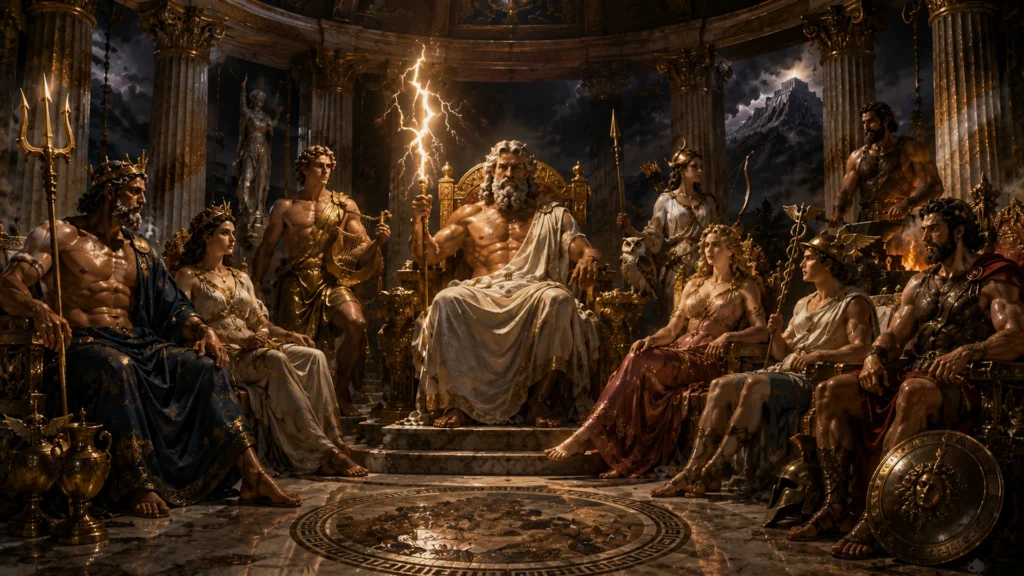
The Greek gods were never simple decorations in old stories.
They were not just colorful characters sitting on clouds, throwing thunderbolts, falling in love, or punishing mortals for dramatic effect. To the ancient Greeks, the gods were a way of explaining a world that felt alive with power.
The sky could turn violent. The sea could destroy a fleet. Desire could ruin a kingdom. Wisdom could save a city. War could make heroes and monsters out of the same men. Death waited below. Fate moved quietly behind everything.
The Greeks gave these forces names.
Zeus. Athena. Apollo. Dionysus. Aphrodite. Ares. Poseidon. Hera. Artemis. Demeter. Hermes. Hephaestus. Hades.
To ask “Who were the Greek gods?” is not only to ask for a list of names. It is to ask what the ancient Greeks believed was moving behind the visible world.
The answer is stranger, deeper and more human than most summaries allow.
The Greek gods were divine forces wearing human faces.
Who Were the Greek Gods?
The Greek gods were the divine beings worshipped, honored, feared and imagined by the ancient Greeks.
They appear in mythology, poetry, art, ritual, temples, festivals, household practices, local cults and the great stories that shaped Greek identity. Some ruled from Mount Olympus. Others belonged to the sea, the underworld, forests, rivers, crossroads, fields, cities and hidden sacred places.
The most famous group is known as the Olympian gods. In the common tradition, these included Zeus, Hera, Poseidon, Demeter, Athena, Apollo, Artemis, Ares, Aphrodite, Hermes, Hephaestus and either Dionysus or Hestia depending on the tradition.
But Greek religion was never limited to one perfect list.
There were older gods, Titans, river gods, sea deities, nymphs, personifications, underworld powers, household gods, local gods and heroic figures who received cult honors after death. The Greek divine world was crowded because life itself was crowded with forces.
A sailor prayed differently from a farmer. A soldier feared different powers from a mother in childbirth. A city honored its patron deity. A family honored the gods of the home. A traveler might look to Hermes. A harvest depended on Demeter. A battlefield belonged to Ares, Athena and the terrible uncertainty of fate.
The gods were not simply believed in. They were encountered through ritual, art, memory, fear, gratitude and the dangerous feeling that human life was never fully under human control.
The Olympians Were Not Perfect Beings
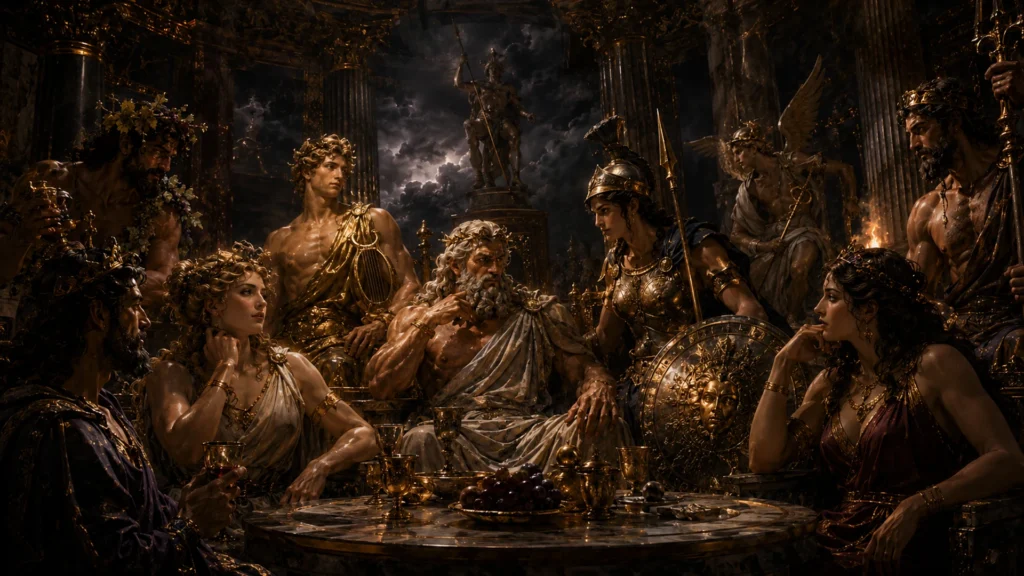
Modern readers often expect gods to be morally perfect.
The Greek gods were not.
They could be wise, generous, protective and magnificent. They could also be jealous, violent, deceptive, lustful, proud and terrifying. They argued with one another. They took sides in wars. They favored certain cities and heroes. They punished insults. They crossed boundaries. They made mistakes.
This is one reason Greek mythology still feels alive.
The Olympians were divine, but they were not emotionally distant. They felt like magnified versions of human power. Zeus was not simply a symbol of order. He was also appetite, authority, storm, kingship and danger. Athena was wisdom, but not softness. Apollo was music and prophecy, but also plague and distance. Aphrodite was beauty and desire, but desire in Greek myth could shatter families, cities and kingdoms.
The gods were not role models in the simple modern sense.
They were revelations.
They revealed what power does when it has no human limits. They revealed how beauty can conquer reason. They revealed how war seduces glory. They revealed how wisdom can be strategic rather than gentle. They revealed how divine favor can save a hero and divine anger can destroy one.
That is why the Greek gods feel less like moral teachers and more like forces that must be understood.
Why the Greek Gods Acted So Human
One of the great mysteries of Greek mythology is why the gods act so human.
They love. They rage. They envy. They compete. They scheme. They desire recognition. They take offense. They remember insults. They form alliances. They change the lives of mortals for reasons that can seem personal, emotional, or brutally unfair.
But this human quality was not a weakness in the mythology.
It was the point.
The Greeks did not imagine the universe as a cold machine. They imagined it as a living drama of powers. Nature, society, emotion and destiny were full of personality. The storm did not feel abstract when it destroyed your ship. Desire did not feel abstract when it ruined your judgment. War did not feel abstract when it took your son.
So the Greeks turned these powers into beings.
This made the world understandable, even when it was not controllable.
A god with a face could be prayed to. A god with a story could be remembered. A god with a domain could be honored. A god with anger could be feared. A god with symbols could be painted, carved, sung and passed down.
The myths did not make life safe.
They made life legible.
The Gods as Forces of Nature and Human Life
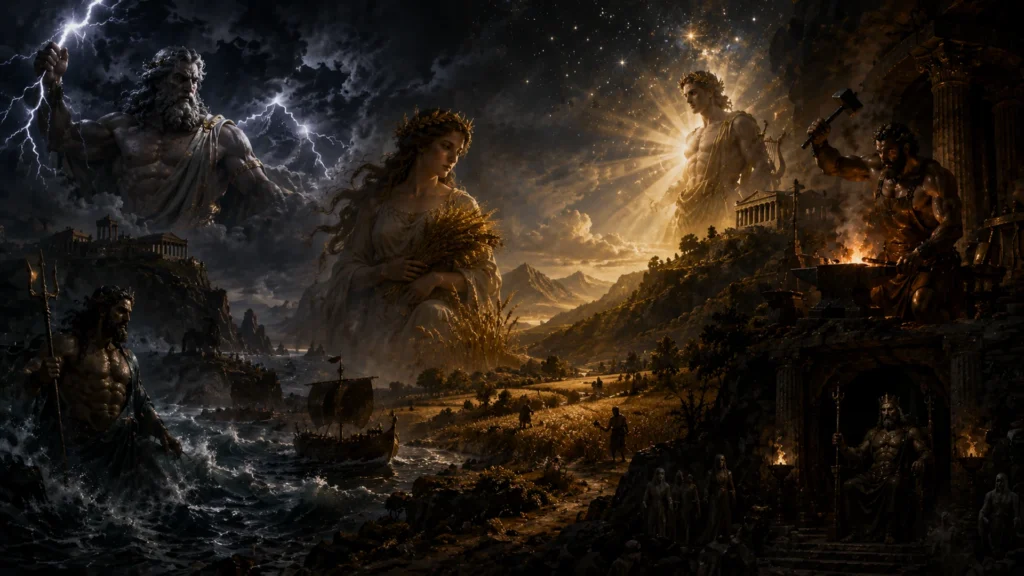
Each Greek god carried a domain, but these domains were never as narrow as modern labels suggest.
Zeus was the sky god and king of the gods, but he was also the image of authority, law, divine order, storm and the dangerous privilege of command. His thunderbolt was not only a weapon. It was the sign that power can descend from above without negotiation.
Poseidon ruled the sea, but the sea was not only water. It was trade, travel, earthquake, shipwreck, wealth, colonization and terror. To live in the Greek world was to live beside water that connected cities and threatened them at the same time.
Hades ruled the underworld. He was not the devil and the Greek underworld was not simply hell. Hades represented the final border. He was wealth beneath the earth, the silence of the dead and the reality that every heroic life ended in shadow.
Athena was wisdom, strategy, crafts and war disciplined by intelligence. She was not merely “smart.” She was the mind that could build a city, guide a hero, weave order and turn violence into tactics.
Apollo was music, prophecy, healing, archery, plague and radiant distance. His light could clarify, but it could also wound. Delphi, his great oracle, became one of the most important sacred centers in the Greek world because human beings have always wanted to ask the future a question.
Artemis belonged to the hunt, wild places, young life and dangerous thresholds. She guarded boundaries between childhood and adulthood, civilization and wilderness, safety and exposure.
Aphrodite was love, beauty, desire and attraction. But Greek myth rarely treats desire as harmless. Aphrodite’s power could create life, bind lovers, start rivalries and pull entire kingdoms toward disaster.
Ares embodied the brutal force of war. Unlike Athena, who represented strategic warfare, Ares was blood heat, aggression, panic and the hunger of battle once reason has begun to fail.
Dionysus was wine, theater, ecstasy, madness, release and the collapse of rigid identity. He is one of the most psychologically disturbing gods because he shows what happens when the civilized mask cracks.
Demeter represented grain, fertility, motherhood and the cycles of growth and loss. Her grief for Persephone was not only a family story. It was a mythic way of imagining the rhythm of seasons, absence, return, hunger and renewal.
Hermes moved between worlds. He was messenger, traveler, trickster, guide, boundary-crosser and escort of souls. He belonged to roads, thresholds, trade, language, luck and the strange spaces between one state of being and another.
Hephaestus was fire, metalworking, craft, invention and the power to shape raw matter into divine objects. In him, the Greeks saw something profound: creation is often born from heat, pressure, imperfection and skill.
Hera was queen of the gods, guardian of marriage and a figure of royal dignity. But in myth she is also angered by betrayal and humiliation. Through Hera, Greek mythology explored the instability inside divine marriage, status, loyalty and wounded honor.
Together, the gods formed a map of existence.
Not a neat map.
A dangerous one.
The Greek Pantheon Was a System of Tension
The Greek gods did not always agree because life does not always agree with itself.
Wisdom and desire can clash. War and law can clash. Family and ambition can clash. Civilization and wilderness can clash. Prophecy and free will can clash. Love and honor can clash. Death and glory can clash.
The Greek pantheon was not a peaceful committee. It was a divine system of tension.
This matters because Greek mythology often begins where two forces collide.
In the Trojan War, divine rivalry becomes human catastrophe. In the story of Persephone, motherly love collides with death and cosmic order. In the myths of heroes, divine favor often comes with a terrible price. In stories of punishment, mortals are not always destroyed because they are evil. Sometimes they are destroyed because they cross a boundary the gods refuse to ignore.
Greek myths are full of these boundaries.
Do not challenge the gods.
Do not confuse mortal beauty with divine beauty.
Do not claim divine honors.
Do not ignore sacred law.
Do not assume intelligence can defeat fate.
Do not believe power makes you untouchable.
The gods were not only worshipped because they were loved.
They were honored because they were dangerous.
The Gods Beyond Olympus
Olympus dominates the imagination, but not every important Greek god belongs neatly to the Olympian circle.
Hades ruled below the earth. Hestia guarded the hearth. Persephone moved between underworld and upper world. Helios drove the sun across the sky in older traditions. Pan haunted wild landscapes. Nymphs lived in rivers, springs, mountains and trees. The Fates measured, allotted and cut the thread of life.
There were also personified powers: Nike as victory, Eros as desire, Hypnos as sleep, Thanatos as death, Eris as strife and Nemesis as divine retribution.
This tells us something important.
The Greeks did not only imagine gods as rulers. They imagined forces as presences.
Victory had a figure. Sleep had a figure. Death had a figure. Revenge had a figure. Strife had a figure. Desire had a figure.
The invisible became visible.
That was one of the great powers of Greek mythology.
It turned human experience into a divine language.
Why the Greek Gods Still Matter Today
The Greek gods still matter because they explain things we still feel.
We may not pray to Zeus before a storm, but we still understand the danger of power. We may not consult Delphi before a decision, but we still want the future to speak clearly. We may not sacrifice to Aphrodite, but we still know desire can overthrow reason. We may not fear Ares as a divine person, but war still transforms human beings into something frightening.
Athena still appears wherever intelligence must control violence. Dionysus still appears wherever order collapses into ecstasy, performance, intoxication, or madness. Hades still waits in every story that asks what death does to meaning. Hermes still moves wherever messages, trade, deception, travel and transitions shape human life.
This is why ancient Greek mythology has never really disappeared.
The gods survive because the forces they represent have not vanished.
Power still rises.
Desire still burns.
War still devours.
Wisdom still struggles.
Beauty still persuades.
Death still waits.
Fate still feels close, even in a modern world that pretends everything can be controlled.
The Greek gods are ancient.
The forces behind them are not.
The Secret Beneath the Gods
The secret of the Greek gods is that they were never only about religion.
They were about recognition.
The Greeks looked at the world and saw that human life was surrounded by powers greater than the individual. Some were natural. Some were emotional. Some were political. Some were cosmic. Some were internal. Some were inherited before a person was even born.
Instead of reducing these forces to theories, the Greeks gave them names, faces, symbols, temples, myths and songs.
That is why the gods remain unforgettable.
They are not perfect.
They are not safe.
They are not simple.
They are the ancient world’s way of saying that human life is shaped by forces we can name, honor, fear, resist and sometimes understand, but never fully command.
The gods were not only above humanity.
They were inside the human condition itself.
Watch Timeless Secrets on YouTube
Watch the myths come alive
Explore Timeless Secrets on YouTube
Enter a cinematic world of Ancient Greece, forgotten mysteries, mythological case files and the darker patterns hidden inside timeless stories.
Visit Timeless Secrets 360Which Olympian Archetype Reflects You?
The Greek gods embodied forces that could protect, create, rule, or destroy. Take the 12-question Olympian Archetype Test to discover which pattern most closely reflects your choices.
Discover Your Olympian ArchetypeFAQ About the Greek Gods
The main Greek gods are usually known as the Olympian gods. The common list includes Zeus, Hera, Poseidon, Demeter, Athena, Apollo, Artemis, Ares, Aphrodite, Hermes, Hephaestus and either Dionysus or Hestia depending on the tradition.
Ancient sources and local traditions did not always use one fixed list, so some variations are normal.
The Greek gods were associated with different forces, domains and areas of life. Zeus was linked with the sky and kingship, Poseidon with the sea, Athena with wisdom and strategy, Apollo with prophecy and music, Aphrodite with love and desire, Ares with war, Demeter with agriculture and Hades with the underworld.
These domains were not just job titles. They helped the Greeks imagine the forces that shaped nature, society, emotion and fate.
The Greek gods were not usually portrayed as purely good or purely evil. They could protect, bless, punish, deceive, inspire or destroy.
This moral complexity is one reason Greek mythology still feels powerful. The gods reflected the unpredictable nature of power itself.
Yes. The ancient Greeks honored the gods through rituals, offerings, sacrifices, festivals, temples, sanctuaries, prayers and local religious customs.
Greek religion was not based on one single scripture. It was practiced through tradition, ritual, community, sacred spaces
and inherited stories.
The Greek gods acted like humans because mythology gave personality to the forces of life. Storms, desire, wisdom, war, death, beauty and fate became easier to understand when imagined through divine figures with emotions, symbols and stories.
Their human qualities made them relatable, but their divine power made them dangerous.
Zeus was usually considered the king of the gods and the most powerful Olympian. He ruled the sky, held the thunderbolt and presided over divine order.
However, Greek mythology often shows that even Zeus must respect older forces such as fate, prophecy and cosmic law.
The Greek gods are still famous because they represent forces that remain part of human life: power, desire, wisdom, violence, beauty, death, creativity, chaos and fate.
Their stories continue to influence literature, art, psychology, film, games, philosophy and modern storytelling.
The gods often reveal the boundaries mortals were not meant to cross, from hubris and broken oaths to fate and divine punishment.