
What Is Greek Mythology?
Greek mythology is often introduced as a collection of ancient stories about gods, heroes, monsters and impossible events.
That description is true, but it is too small.
Greek mythology was not just a library of old tales. It was one of the great imaginative systems of the ancient world. Through myth, the Greeks explored creation, power, love, betrayal, punishment, madness, pride, war, death, justice, beauty and the limits of human control.
The myths did not always give clean answers. In many cases, they gave better questions.
Why do powerful people become dangerous?
Why does beauty attract violence?
Why do heroes destroy the very worlds they are supposed to save?
Why do families inherit crimes they did not begin?
Why does wisdom so often arrive too late?
This is why Greek mythology still survives.
It does not feel like dead folklore. It feels like a mirror.
The gods are not distant abstractions. They are desire, thunder, strategy, jealousy, light, intoxication, love, memory, war, harvest, sea, death and fate given names and faces. The heroes are not simple role models. They are brilliant, wounded, ambitious, violent, loyal, arrogant, broken and unforgettable. The monsters are not merely creatures to be defeated. Many of them are warnings.
To understand Greek mythology is not only to learn who Zeus, Athena, Achilles, Medusa, Perseus, or Odysseus were.
It is to understand how the ancient Greeks imagined the forces that still move human life.
The Greek Gods Were Not Perfect Beings
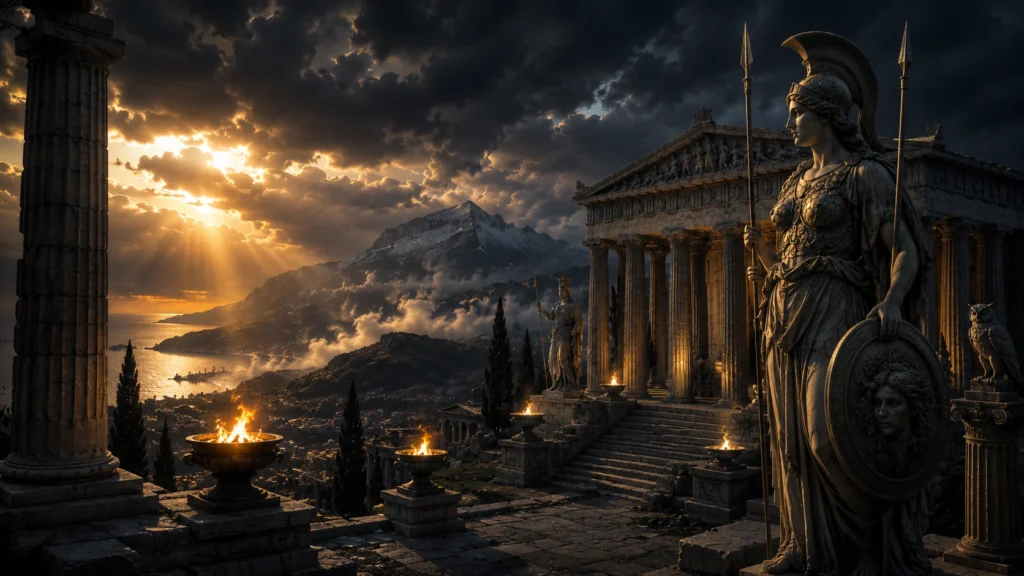
Modern readers sometimes expect gods to represent moral perfection.
Greek mythology does something stranger.
The Greek gods are powerful, immortal, beautiful and dangerous, but they are rarely perfect. They desire. They compete. They punish. They protect. They deceive. They favor some mortals and ruin others. They are not simply examples of goodness. They are forces of existence made personal.
Zeus is not merely a king in the sky. He is authority, order, storm, law, appetite and unstable power.
Athena is not only wisdom. She is strategic intelligence, civic order, disciplined violence, craft and the cold clarity of the battlefield.
Apollo is not only beauty and music. He is light, prophecy, plague, purification and the terrifying precision of divine distance.
Aphrodite is not only romance. She is desire as a cosmic force, the attraction that can create life, destroy judgment and collapse kingdoms.
Hera is not only jealousy. She is marriage, legitimacy, queenship, wounded dignity and the rage of a sacred order violated.
Dionysus is not only wine. He is ecstasy, theater, madness, liberation and the force that breaks through every system trying to deny the irrational.
The Greek gods mattered because they made invisible powers visible.
A storm became Zeus.
A sudden insight became Athena.
A dangerous desire became Aphrodite.
A prophetic warning became Apollo.
A loss of control became Dionysus.
The ancient world did not separate psychology, nature, religion and story as cleanly as the modern world often does. Myth allowed these forces to speak.
That is why the gods are so memorable. They are not flat symbols. They are contradictions.
They explain why power can protect and corrupt at the same time.
Heroes Were Not Always Moral Examples
Greek heroes are often remembered as champions.
But many Greek heroes are not safe.
Achilles is the greatest warrior in the Iliad, but his greatness burns too hot. His rage becomes larger than the war around him. He is heroic, but he is also terrifying. His honor matters so intensely that it consumes him.
Heracles is the strongest of heroes, but his strength does not protect him from suffering, madness, guilt, or servitude. His life is not simply a victory story. It is a cycle of labor, violence, punishment and endurance.
Odysseus is clever, adaptable and difficult to destroy. But his intelligence is not innocent. He survives through disguise, deception, patience, storytelling and manipulation. He is a hero of the mind, but also a warning about the cost of cunning.
Perseus slays Medusa and rescues Andromeda, yet even his story moves through fear, prophecy, royal anxiety and divine assistance. Greek heroism is rarely simple.
Agamemnon leads kings to Troy, but his command is stained by sacrifice, pride and family catastrophe. His story asks whether leadership can survive when power demands blood.
These figures are not superheroes in the modern sense.
They are case studies.
Greek mythology often treats greatness as a dangerous condition. The hero is exceptional, but that exception creates pressure. The hero stands closer to the gods than ordinary mortals, but that closeness can deform a life.
A Greek hero may win glory and still lose peace.
He may defeat the monster and still fail the moral test.
He may save a city and destroy a family.
He may be remembered forever because he could not live quietly.
This is one reason the myths remain powerful. They do not pretend that greatness is clean.
They ask what greatness costs.
Monsters Were Ancient Warnings
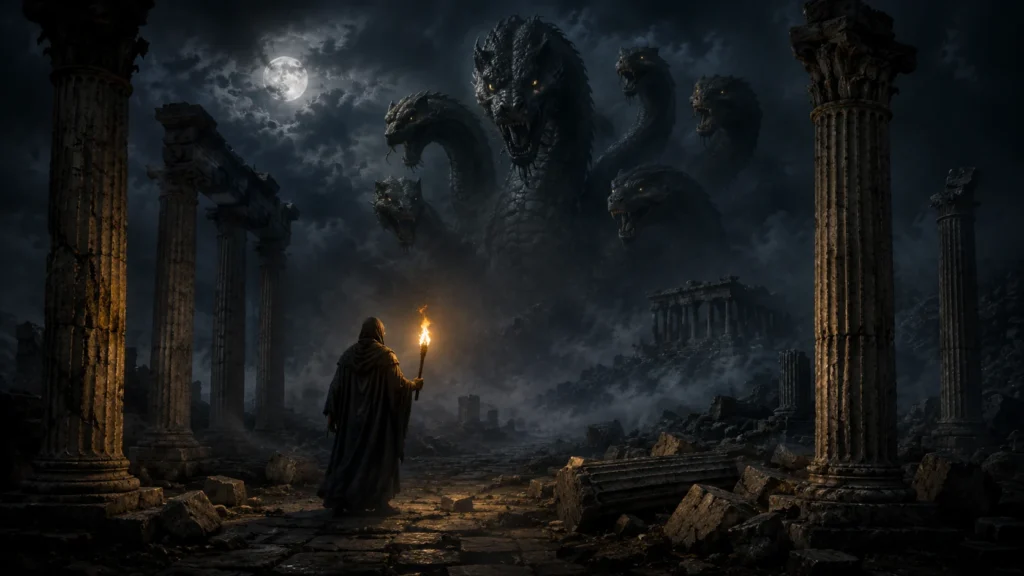
Greek monsters are some of the most famous creatures in world mythology: Medusa, the Minotaur, the Hydra, the Chimera, the Sirens, the Sphinx, Cerberus, Scylla, Charybdis.
At first, they may seem like obstacles.
The hero must defeat the creature. The city must escape the terror. The traveler must survive the road.
But Greek monsters often carry deeper meaning.
Medusa is not only a monster with snakes for hair. Her image appears throughout ancient art with an intensity that suggests something more than simple horror. She is fear, danger, protection, otherness and violated boundaries gathered into one unforgettable face.
The Minotaur is not only a beast in a labyrinth. It is the hidden consequence of royal wrongdoing, shame locked beneath architecture, the secret a civilization builds walls around.
The Hydra is not only a many-headed serpent. It is the problem that multiplies when attacked in the wrong way.
The Sirens are not only seductive singers. They are the danger of knowledge, beauty and desire when they call a person away from life.
The Sphinx is not only a riddle-maker. She represents the deadly encounter between intelligence and survival. To fail the question is to perish.
Greek monsters often reveal what societies fear.
The uncontrolled body.
The foreign wilderness.
The dangerous woman.
The corrupted bloodline.
The punishment hidden inside a palace.
The appetite that cannot be governed.
The truth no one wants to face.
In Timeless Secrets terms, the monster is rarely just the monster.
Sometimes the monster is the evidence.
Myths Explained What Logic Could Not
Before scientific explanation became separate from sacred story, myth helped ancient people speak about the world’s mysteries.
Why do seasons change?
Why do storms come?
Why does disease strike?
Why do people die?
Why do families repeat the same disasters?
Why do cities rise and fall?
Why does pride invite ruin?
Why does suffering appear to follow a pattern?
Greek mythology did not always answer these questions in a literal way. Instead, it gave them shape.
Demeter and Persephone gave emotional form to seasonal loss and return.
Prometheus gave fire, craft, rebellion, punishment and human progress a mythic body.
Pandora gave a story to suffering, curiosity and the irreversible release of trouble into the human world.
The House of Atreus gave inherited violence a family tree.
Oedipus gave fate, blindness, knowledge and self-discovery one of the most disturbing patterns in literature.
The Trojan War gave heroic glory and civilizational trauma a shared stage.
These myths do not work because ancient people were simplistic.
They work because human experience is not simple.
A myth can hold contradictions that ordinary explanation struggles to contain. It can say that desire is beautiful and destructive. That wisdom can save and isolate. That power can create order and produce catastrophe. That a victory can still be a curse.
Greek mythology gave ancient people a symbolic language for reality.
It still does.
Why Greek Mythology Still Matters Today
Greek mythology survives because it continues to explain patterns we recognize.
Modern films still use Greek mythic structures: the chosen hero, the impossible quest, the descent into darkness, the fatal flaw, the cursed family, the forbidden knowledge, the monster that reflects the hero’s own fear.
Psychology still borrows Greek names: narcissism from Narcissus, the Oedipus complex from Oedipus, the Achilles heel from Achilles, a mentor from Mentor in the Odyssey and countless other examples that reveal how deeply these stories shaped the vocabulary of the modern imagination.
Politics still echoes Greek myth. Leaders still resemble Agamemnon when they sacrifice others for strategy. Public figures still fall like Icarus when ambition rises faster than wisdom. Societies still create scapegoats when fear becomes easier than responsibility.
Personal life still feels mythic. People still battle inner labyrinths. They still hear Siren songs. They still inherit family patterns. They still mistake victory for healing. They still turn pain into identity.
This is why Greek mythology is not merely ancient.
It is recurring.
The names are old, but the patterns are not.
Zeus is still power without restraint.
Athena is still disciplined intelligence.
Dionysus is still the return of what society represses.
Medusa is still the face people fear before they understand the story behind it.
Achilles is still wounded greatness.
Odysseus is still survival through intelligence.
Icarus is still ambition without measure.
The labyrinth is still the structure people build around shame.
The myths remain because they were never only about the past.
They were about us.
The Secret Beneath the Myths
The secret of Greek mythology is that it rarely tells us what to think.
It shows us what humans become under pressure.
A king under pressure may sacrifice the innocent.
A hero under pressure may become a weapon.
A god under pressure may reveal the danger of unchecked power.
A victim under pressure may be called a monster.
A civilization under pressure may turn its fears into sacred stories.
That is why these myths still feel alive.
They are not preserved only because they are beautiful. They are preserved because they are useful. They give language to things people still experience but struggle to name: rage, envy, longing, grief, shame, pride, fate, transformation, punishment and the hunger to be remembered.
Greek mythology is not just about gods on Olympus or monsters in caves.
It is about the forces that move beneath the surface of human life.
The ancient Greeks gave those forces names.
And somehow, thousands of years later, the names still answer.
Watch Timeless Secrets on YouTube
Watch the myths come alive
Explore Timeless Secrets on YouTube
Enter a cinematic world of Ancient Greece, forgotten mysteries, mythological case files and the darker patterns hidden inside timeless stories.
Visit Timeless Secrets 360Step Inside the Myth
Greek mythology survives because its conflicts still mirror modern ambition, loyalty, desire, fear and transformation. Discover which Olympian pattern appears most strongly in your own choices.
Take the Greek God QuizFAQ About Greek Mythology
Greek mythology is the body of traditional stories told by the ancient Greeks about gods, heroes, monsters, origins, rituals, the natural world and human destiny.
These myths were not only entertainment. They helped ancient communities think about religion, power, nature, death, morality, family, suffering and the unknown.
The ancient Greeks used myths to explain the world around them, preserve cultural memory, explore divine power and give symbolic meaning to human experience.
A myth could explain a natural event, a ritual, a family curse, a city’s identity or a psychological truth that ordinary language could not fully express.
They were often both.
Many Greek myths were connected to religious worship, festivals, temples, sacrifices and local traditions. At the same time, the stories can also be read symbolically, psychologically, politically and artistically.
Ancient sources do not always agree and different cities or poets sometimes preserved different versions of the same myth.
The most famous Greek gods include Zeus, Hera, Athena, Apollo, Artemis, Aphrodite, Ares, Hermes, Poseidon, Demeter, Hephaestus, Hestia and Dionysus.
These gods were not simply characters. Each one represented powers, domains and tensions that shaped ancient Greek imagination and religious life.
Greek mythology remains popular because its stories still speak to human patterns: ambition, love, betrayal, pride, fear, transformation, revenge, sacrifice and the search for meaning.
The myths continue to influence literature, film, psychology, philosophy, art, branding, language and modern storytelling.
Greek myths often worked as warning systems, preserving patterns of hubris, desire, prophecy, punishment and hidden consequence.
Explore More Ancient Greek Secrets
Suggested editable internal links:
