
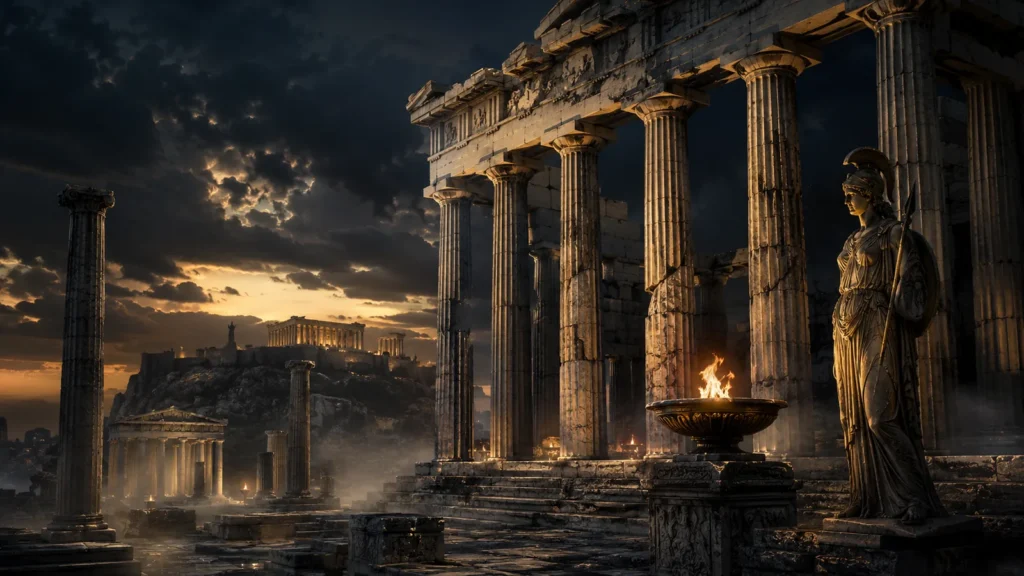
Ancient Greek civilization did not disappear.
It survives beneath the modern world like an old foundation beneath a new city. We walk across it every day without always noticing it. We hear it in political language, see it in architecture, inherit it through philosophy, repeat it through stories and feel it in the questions we still ask about power, justice, beauty, truth, fate and human weakness.
The ancient Greeks did not give the world a perfect civilization. Their world was full of conflict, exclusion, ambition, violence, rivalry and contradiction. But that is exactly why it still matters. Ancient Greece was not important because it was flawless. It was important because it turned human struggle into thought, myth, drama, science, politics and memory.
That is why Ancient Greek Secrets exists.
Not to worship the past. Not to turn history into decoration. But to return to the ancient world with sharper eyes, asking what still lives inside these stories, monuments, ruins, gods, heroes, philosophers, punishments, betrayals and discoveries.
Because sometimes, the oldest stories are not old at all.
The Ancient World Beneath the Modern One
When people think of ancient Greece, they often imagine marble temples, philosophers in robes, heroic statues, bronze armor and myths of gods who looked dangerously human. Those images are part of the story, but they are only the surface.
The deeper legacy of ancient Greece is not only in what the Greeks built. It is in how they thought.
They asked what makes a city just. They questioned whether power should belong to kings, aristocrats, citizens or law. They argued about virtue, knowledge, beauty, courage, pleasure and the soul. They gave dramatic form to guilt, pride, revenge, loyalty and fate. They imagined gods who were immortal but not morally simple. They told stories where heroes could be both glorious and ruined.
This is why ancient Greek civilization continues to shape the modern imagination. It gave later cultures a language for thinking about the human condition.
The modern world did not copy ancient Greece directly. History is never that simple. Ideas moved through conquest, translation, adaptation, Rome, Byzantium, the Renaissance, Christianity, Islamic scholarship, modern education, archaeology and political reinvention. But again and again, the Greek world returned as a source of questions, models, warnings and symbols.
Ancient Greece became one of the deep reference points of Western civilization because it did not only preserve answers. It preserved tensions.
Freedom and order. Beauty and violence. Reason and myth. Individual glory and civic duty. Law and revenge. Fate and choice.
Those tensions still define us.
Ancient Greece Was Not One Simple Thing
To understand the importance of ancient Greece, we must avoid treating it as one clean, unified block.
Ancient Greece was not a single country in the modern sense. It was a world of city-states, colonies, sanctuaries, islands, rivalries, dialects, alliances, wars, trade routes and shared traditions. Athens was not Sparta. Sparta was not Corinth. Corinth was not Thebes. The Greek world extended across the Aegean and beyond, touching Asia Minor, southern Italy, Sicily, North Africa, the Black Sea and the wider Mediterranean.
The Greeks themselves were shaped by earlier and neighboring civilizations. They did not emerge in isolation. The ancient Mediterranean was a world of exchange: Egyptian, Near Eastern, Anatolian, Minoan, Mycenaean, Phoenician, Persian and other influences all mattered. Ancient Greek civilization became powerful not because it appeared from nowhere, but because it absorbed, transformed, argued with and reimagined the world around it.
That makes its legacy even more compelling.
Greece was not a sealed temple. It was a crossroads.
Its myths carried older echoes. Its alphabet developed through contact with Phoenician writing. Its art changed through trade and contact. Its politics evolved through crisis. Its philosophy emerged from debate, travel, conflict and curiosity.
The Greek achievement was not purity. It was transformation.
The Greek Question: What Does It Mean to Be Human?
The ancient Greeks were obsessed with the human being.
Not the perfect human being. The exposed one.
Their literature and mythology return again and again to the same dangerous questions: What happens when pride becomes blindness? What does power do to the soul? Can a person escape fate? Is revenge justice or only another form of ruin? What does a hero owe to a city? What does a child inherit from a parent’s violence? What happens when the gods demand what human beings cannot bear?
These questions run through Homer, tragedy, mythology, philosophy and historical writing. Achilles is not merely strong; he is rage made unforgettable. Odysseus is not merely clever; he is intelligence under pressure. Agamemnon is not merely a king; he is the crisis of command. Antigone is not merely defiant; she is the collision between sacred duty and political law. Medusa is not merely a monster; she is a story about fear, transformation and the way a culture remembers what it cannot face.
This is where ancient Greece becomes timeless.
The stories survive because they are not locked inside their own century. They reveal patterns that keep returning in different clothes: ambition, shame, betrayal, sacrifice, punishment, silence, pride, grief and the hunger to be remembered.
Ancient Greece matters because it gave these patterns shape.
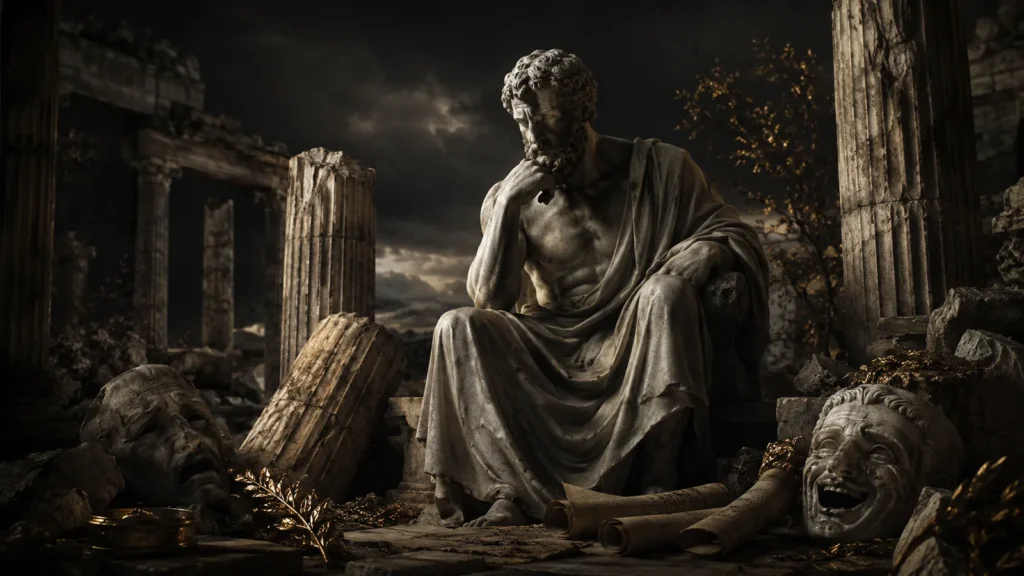
Democracy, Debate and the Political Imagination
One of the most famous legacies of ancient Greece is democracy, especially the democracy of classical Athens.
But this must be handled carefully. Athenian democracy was not modern democracy. Women, enslaved people and many residents were excluded from citizenship. Participation was limited to a specific body of male citizens. It was direct, intense and deeply different from modern representative systems.
Even so, the Athenian experiment changed political imagination.
It suggested that political life did not have to belong only to kings. It could belong to citizens. It could involve assemblies, debate, public speaking, voting, accountability, law courts, persuasion and civic participation. It showed that a city could become a place where power was argued over in public, not only inherited in private.
The ancient Greeks also gave us a vocabulary of politics. Words like democracy, politics, tyranny, aristocracy, oligarchy and rhetoric carry Greek roots or Greek political memory. More importantly, they gave later civilizations a set of political questions that never disappeared.
Who should rule? What makes power legitimate? Can citizens govern themselves? What happens when persuasion becomes manipulation? Can democracy survive ambition? Can law restrain revenge? Can freedom exist without responsibility?
These questions are not museum pieces.
They are still on the table.
Philosophy and the Courage to Question Everything
If Greek politics asked who should rule the city, Greek philosophy asked who should rule the self.
The philosophers of ancient Greece did not all agree. That is part of their power. Socrates questioned certainty. Plato explored justice, truth, education, the soul and the dangers of illusion. Aristotle studied ethics, politics, logic, poetry, biology and the structures of knowledge. The Stoics later asked how a person could remain free inside a world they could not fully control. Epicureans explored pleasure, fear, friendship and peace of mind. Earlier thinkers wondered what reality itself was made of.
Greek philosophy shaped the Western intellectual tradition because it made questioning into a discipline.
It was not enough to inherit an answer. One had to examine it. Define it. Test it. Defend it. Refine it.
That spirit still matters today. Every serious discussion about ethics, politics, education, logic, virtue, happiness, beauty, rhetoric and knowledge carries traces of Greek philosophical inquiry, even when the names are not mentioned.
Ancient Greek philosophy did not remove mystery from the world. It taught people how to stand inside mystery without surrendering their mind.
That is one of its greatest gifts.
Greek Mythology as Ancient Psychology
Greek mythology is often treated as fantasy, but that is too small a word for it.
The myths were sacred stories, cultural memory, poetic imagination, social warning, political reflection, family drama and psychological map. They gave visible form to invisible forces. Fear became a monster. Desire became punishment. Pride became a fall. Grief became a ghost. Memory became a curse. Power became divine, but never innocent.
This is why Greek mythology remains so powerful for Timeless Secrets and Ancient Greek Secrets.
The myths do not simply ask, “What happened?”
They ask, “What does this reveal?”
Medusa reveals how fear can turn a victim into a symbol. Tantalus reveals the torture of endless desire. Sisyphus reveals the burden of repeated striving. Andromeda reveals how communities can sacrifice innocence to avoid facing their own guilt. Agamemnon reveals the terrible cost of command. Electra reveals how grief can become identity. Marsyas reveals what happens when artistic defiance challenges divine power.
These myths are ancient, but their patterns are modern.
Every generation creates new monsters. Every society chooses which stories to honor and which witnesses to silence. Every age invents noble reasons for sacrifice. Every powerful system finds ways to call its violence necessary.
Greek mythology still haunts us because it understands human beings too well.
Art, Beauty and the Human Form
Ancient Greek art changed the way later civilizations imagined beauty.
Greek artists did not simply copy the human body. They searched for proportion, balance, movement, tension and ideal form. Sculpture, pottery, temple architecture and visual storytelling all carried a sense that beauty was not random. It could be studied. Measured. Refined. Composed.
The classical Greek body became one of the great visual languages of Western art. It shaped Roman sculpture, Renaissance ideals, neoclassical architecture, academic painting, public monuments and modern ideas of harmony and proportion. Even today, when people describe a building as “classical” or a pose as “heroic,” they are often speaking through a visual grammar that Greece helped create.
But Greek beauty was never only decorative.
A temple was not just a building. A statue was not just a body. A vase was not just an object. These works carried religion, politics, memory, athletic ideals, mythic scenes, civic pride and philosophical ideas about order.
Beauty, for the Greeks, could be a way of thinking.
That is why ruins still move us. Even broken columns suggest an ancient belief that form mattered. That proportion could discipline chaos. That the human figure could carry divine presence. That stone could hold memory.
Science, Measurement and the Hunger to Understand
Ancient Greece also helped shape the scientific imagination.
This does not mean the Greeks invented science alone. They inherited and learned from older traditions, including Egyptian and Babylonian mathematics, astronomy and practical knowledge. But Greek thinkers gave new forms to inquiry, proof, classification, geometry, medicine, astronomy and natural philosophy.
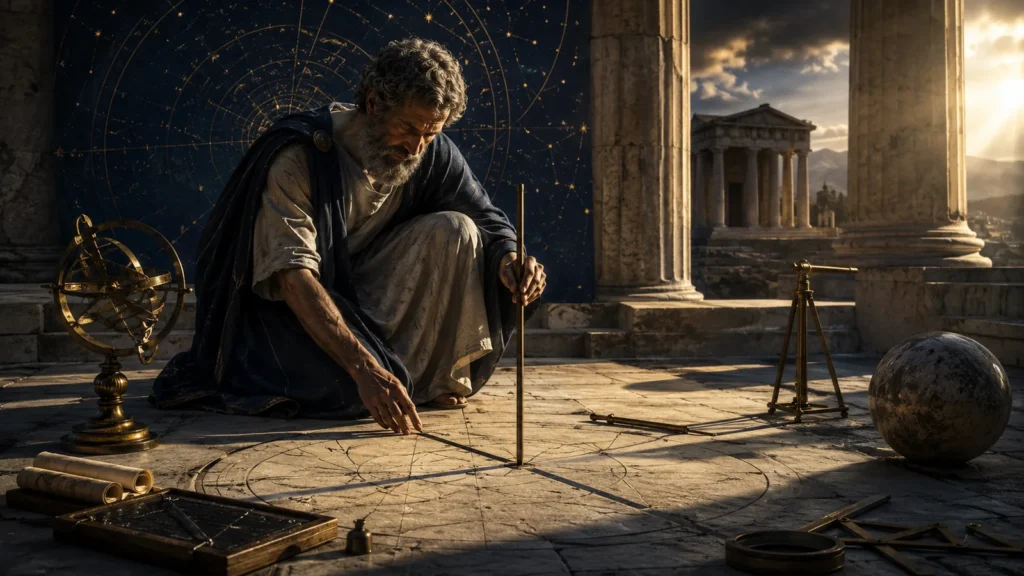
Eratosthenes estimated the circumference of the Earth using shadows and geometry. Archimedes explored mechanics, buoyancy and mathematical principles. Euclid’s geometry became a foundation of mathematical education for centuries. Hippocratic medicine helped move healing toward observation, diagnosis and natural explanations. Aristarchus proposed that the Earth moves around the Sun long before that idea became accepted.
What matters here is not that every Greek theory was correct. Many were not. What matters is the hunger to understand.
The Greeks looked at the world and asked whether its patterns could be reasoned through. Could disease have natural causes? Could the stars be mapped? Could the Earth be measured? Could logic reveal structure? Could mathematics describe reality?
That impulse helped shape later scientific traditions. It also gives Ancient Greek Secrets a wider mission. The ancient world is not only myth and gods. It is also measurement, experimentation, engineering, medicine, astronomy and the courage to ask how the world works.
The mysterious and the rational were not always enemies.
In ancient Greece, they often stood side by side.
How Greek Civilization Reached the Western World
The influence of ancient Greece did not travel in a straight line.
Greek culture spread through colonization, trade, warfare, education, literature and conquest. The conquests of Alexander the Great expanded Greek language and culture across a vast Hellenistic world. Later, Rome absorbed and adapted Greek art, mythology, philosophy, education and literature. Roman elites studied Greek. Greek art filled Roman spaces. Greek gods were identified with Roman gods. Greek ideas entered Roman intellectual and political life.
Through Rome, Greek culture became one of the major inheritances of Europe.
Later, Greek texts and ideas continued to move through Byzantine scholars, Islamic intellectual traditions, medieval manuscript culture and Renaissance humanism. The story is complex, layered and sometimes broken by loss. But the result is clear: ancient Greece became one of the central sources through which later civilizations thought about politics, art, literature, philosophy, science, education and the human condition.
That is why ancient Greece feels both distant and familiar.
It belongs to the past, but it keeps reappearing.
In a courthouse column. In a university motto. In a political debate. In a tragic hero. In a statue. In a word. In a question.
Why Timeless Secrets Keeps Returning to Ancient Greece
Timeless Secrets returns to ancient Greece because the ancient world still speaks in patterns.
The myths are not just stories about gods and monsters. They are case files of human behavior. The ruins are not just stones. They are evidence of memory. The philosophers are not just names from schoolbooks. They are voices asking whether we have examined our lives, our desires, our fears and our societies honestly enough.
Ancient Greek Secrets exists to explore that deeper world.
Some articles will examine myths. Others will investigate ancient science, forgotten histories, sacred places, strange rituals, Greek gods, heroes, tragedies, symbols, ruins and mysteries. Some will accompany Timeless Secrets videos. Others will expand ideas that a short video can only introduce.
The goal is not to flatten the ancient world into simple lessons.
The goal is to reopen it.
To ask what the myth hides beneath the surface. To ask why a story survived. To ask who benefits from the official version. To ask why a punishment feels symbolic. To ask why a monster was created. To ask why an ancient invention still feels modern. To ask what we have forgotten and what has been waiting for us to notice again.
Ancient Greece is not only a subject.
It is a lens.
The Secret Beneath the Civilization
The secret of ancient Greek civilization is not that it gave the world perfect answers.
It did something more powerful.
It gave the world unforgettable questions.
What is justice? What is beauty? What is courage? What is truth? What does power reveal? What does suffering teach? What does a society choose to remember? What does it choose to bury? When does a hero become dangerous? When does a victim become a monster? When does law become theater? When does myth become evidence?
These questions still matter because we still live inside them.
That is why ancient Greece continues to shape the modern world. Not as a dead civilization preserved behind glass, but as a living inheritance. A voice under the stone. A pattern inside the story. A mirror that keeps returning, no matter how modern we believe ourselves to be.
Ancient Greek civilization survives because it understood something timeless:
Human beings change their tools faster than they change their nature.
And the ancient world still remembers what we try to forget.
Watch Timeless Secrets on YouTube
Watch the myths come alive
Explore Timeless Secrets on YouTube
Enter a cinematic world of Ancient Greece, forgotten mysteries, mythological case files and the darker patterns hidden inside timeless stories.
Visit Timeless Secrets 360What Warning Is Hidden Inside Your Strength?
Every ancient warning begins with a human strength pushed too far. Take the Olympian Archetype Test to discover the warning hidden inside yours.
Which Greek God Are You?FAQ About Ancient Greek Civilization
Ancient Greek civilization is important because it helped shape many of the ideas, stories and systems that later influenced the Western world. Its legacy can be seen in philosophy, politics, literature, theater, art, architecture, mathematics, science, medicine and mythology.
But its importance is not only about invention. Ancient Greece mattered because it asked questions that still feel alive: What is justice? What is truth? What makes a good life? What happens when power becomes dangerous? What does a society choose to remember and what does it choose to hide?
Ancient Greece did not create Western civilization alone. That would be too simple. The Western world was shaped by many civilizations, including Egyptian, Mesopotamian, Phoenician, Persian, Roman, Byzantine, Christian, Islamic and later European traditions.
But ancient Greece became one of the central foundations of Western civilization. Greek philosophy, political thought, mythology, art, literature and science were preserved, transformed and transmitted through Rome, Byzantium, the Renaissance and modern education. Its influence is not isolated. It is woven into a much larger historical chain.
Ancient Greek philosophy influenced the modern world by making questioning itself a discipline. Thinkers like Socrates, Plato, Aristotle and later philosophical schools explored ethics, politics, logic, knowledge, education, happiness, virtue and the nature of reality.
Modern debates about democracy, morality, leadership, truth, education, rhetoric and self-mastery still carry echoes of Greek philosophical inquiry. The ancient Greeks did not simply ask what people believed. They asked whether those beliefs could survive examination.
Greek mythology is still relevant because it gives symbolic form to human patterns that never disappeared. The myths explore pride, revenge, desire, sacrifice, grief, punishment, ambition, fear and transformation.
Stories like Medusa, Tantalus, Sisyphus, Andromeda, Agamemnon and Electra still speak to modern readers because they reveal emotional and social truths. Greek mythology is not only about gods and monsters. It is also about power, memory, guilt, silence and the hidden forces that shape human behavior.
Ancient Greece contributed to science and knowledge through mathematics, geometry, astronomy, medicine, natural philosophy, engineering and observation. Figures such as Euclid, Archimedes, Eratosthenes, Hippocrates and Aristarchus helped shape later ways of studying the world.
Not every ancient Greek theory was correct and Greek thinkers also inherited knowledge from older civilizations. Still, their work helped strengthen the idea that nature could be studied through reason, measurement, argument and evidence.
Ancient Greek Secrets focuses on ancient Greece because its myths, ruins, gods, heroes, philosophers, mysteries and discoveries still reveal patterns that matter today. The ancient Greek world is not only a subject of the past. It is a lens for understanding human nature, power, fear, beauty, ambition, justice and memory.
Through Timeless Secrets and Ancient Greek Secrets, these stories are reopened not as simple summaries, but as deeper investigations into what the ancient world still remembers.
Many Greek stories also preserved recurring warning patterns about pride, power, fate and civic collapse. Explore the Ancient Greek Warnings Index for a broader map of these patterns.
Explore More Ancient Greek Secrets
Suggested editable internal links:
